
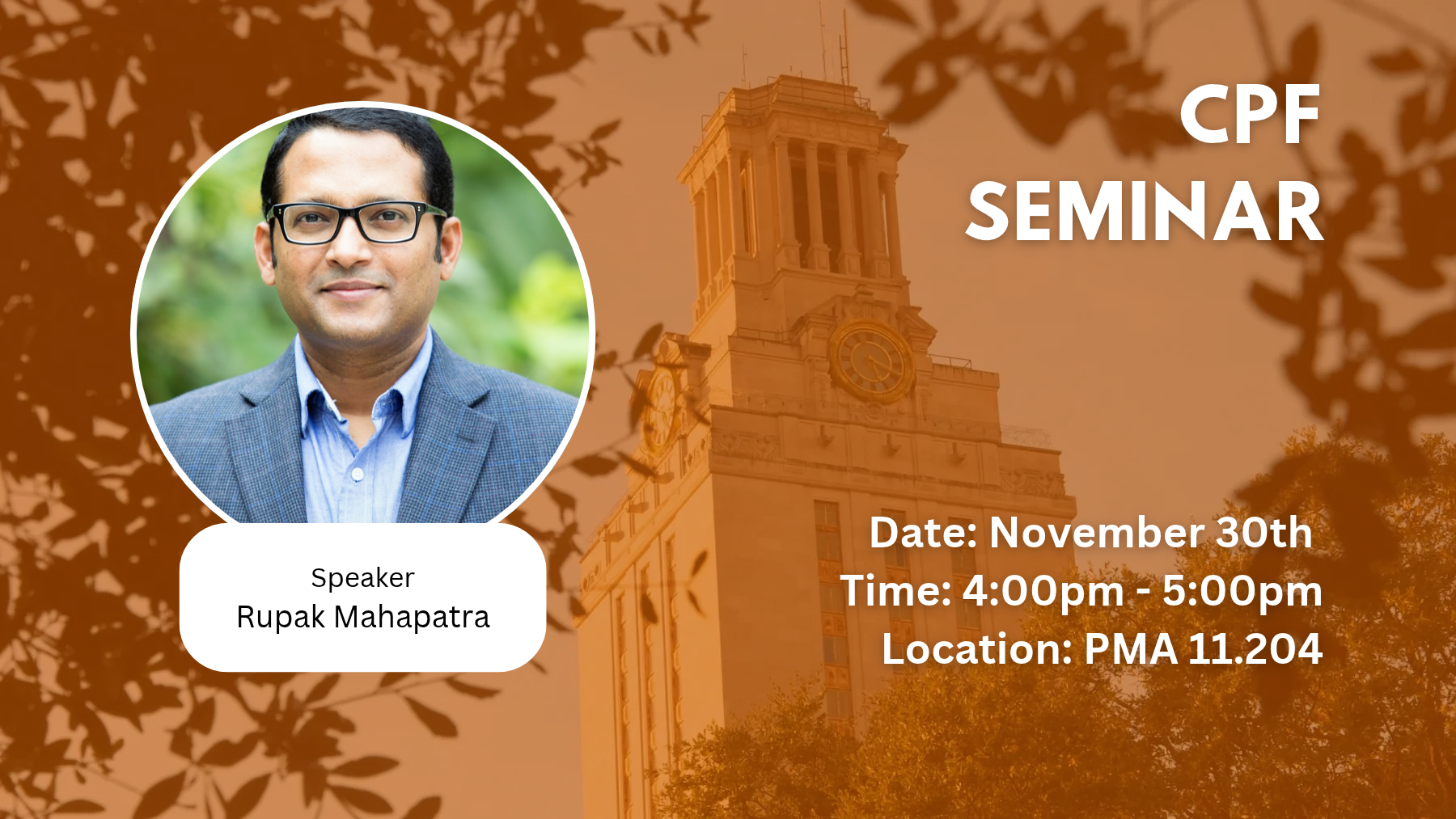
CPF Seminar with Rupak Mahapatra
Nov
30
2026
Nov
30
2026
Abstract
While astronomical observations show evidence of Dark Matter, searches for its particle
nature have been elusive. Leading candidates are Weakly Interacting Massive Particles (WIMP) and
Axions. Detection of a WIMP recoiling against a terrestrial detector takes us to the quantum realm due to
the extremely small amount of energy expected to be deposited by such a weak interaction. Our group is
a world leader in the design and development of low-threshold superconducting Transition Edge Sensors
(TES) that operate at a few mK temperature and utilize the macroscopic quantum phenomenon of
quasiparticle tunneling first demonstrated by the 2025 Nobel prize winners. Our TAMU-fabricated
semiconductor detectors power two leading Dark Matter experiments, SuperCDMS and TESSERACT,
which are collaborations of more than 3 dozen universities and half a dozen national labs. I will present
world-leading low-mass Dark Matter search results recently achieved by the TESSERACT New Initiative
in Dark Matter (NIDM) project, the only one approved by the DOE for a new generation of highly sensitive
searches.
Through the Mitchell Institute Neutrino Experiment at Reactor (MINER) experiment our group also
pioneered the use of these low-threshold cryogenic detectors to search for Coherent Elastic Neutrino
Nucleus Scattering (CENNS) that allows detection of low energy MeV-scale neutrinos from a nuclear
reactor and allows searches for new physics beyond the standard model. MeV-scale neutrinos from the
Sun pose the ultimate background for our WIMP searches, hence understanding the nature of their
interaction with the same weak scale cross-section as the WIMP, is a highly sought after experimental
program. MINER is currently in the commissioning phase at the High Flux Isotope Reactor (HFIR) at
ORNL and was founded by Texas A&M, UT Austin, and USD.
Bio: Rupak Mahapatra is a Professor of Physics in the Texas A&M Department of Physics and
Astronomy and the Mitchell/Heep Endowed Chair in Experimental Particle Physics. He received his Ph.D.
from the University of Minnesota and completed postdoctoral work at the University of California, Santa
Barbara. He is an international expert in high-energy particle physics with significant experience in
building particle detectors and analyzing related data. He received the Department of Energy Early
Career Research Award in 2010. He is a principal investigator with the SuperCDMS experiment, founded
the MINER experiment, and his detectors contributed to the creation of TESSERACT.