
IFS Qualifying Exam
Event starts on this day
Apr
23
2026
Featured Speaker(s):
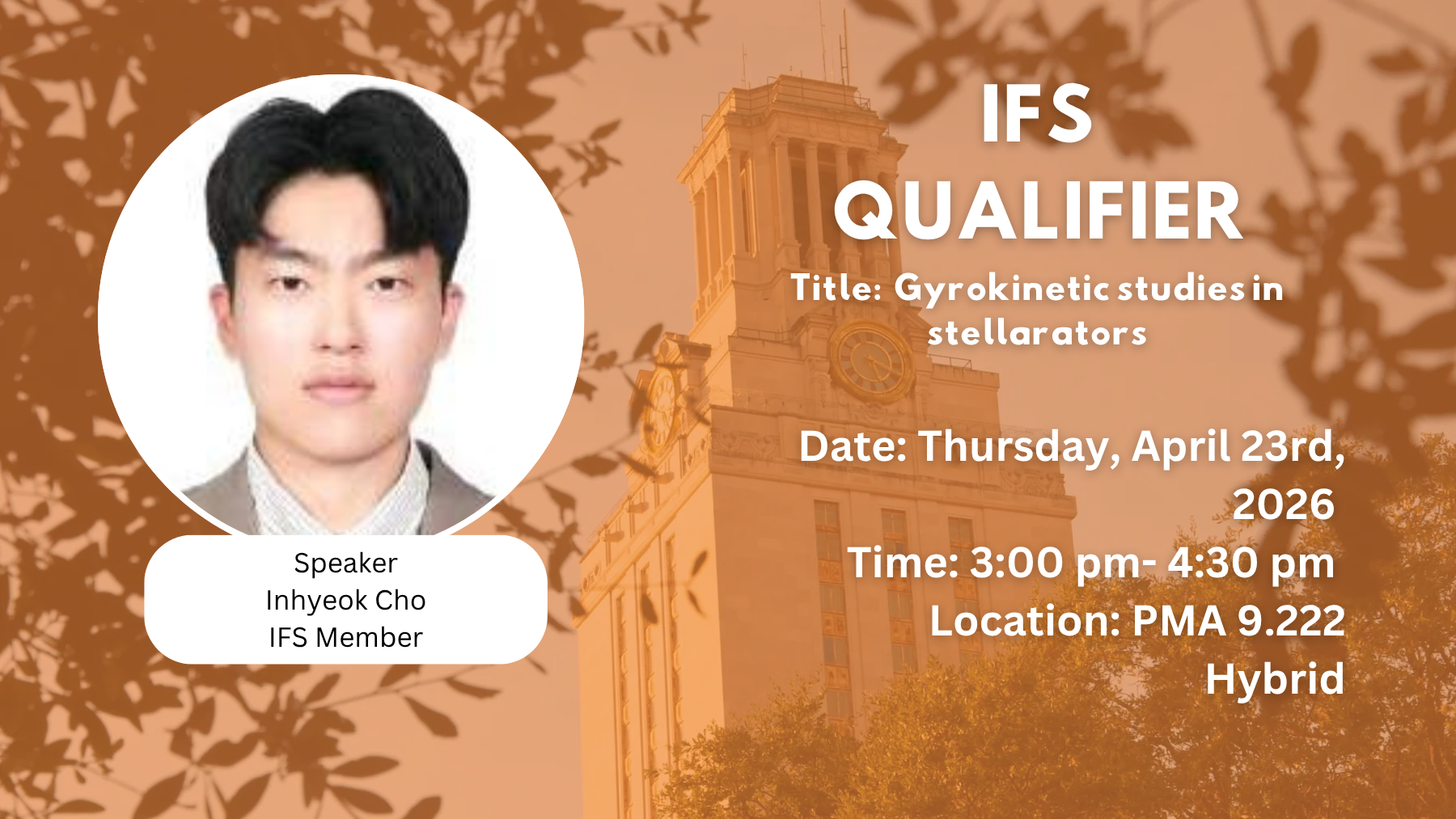
Inhyeok Cho
Event starts on this day
Apr
23
2026
Gyrokinetic studies in stellarators
Description
Abstract: As the global demand for energy is accelerating at an unprecedented rate, nuclear fusion is becoming a promising option for the next generation of carbon-free baseline power plants. Stellarators, one of the leading concepts for fusion pilot plants, provide a promising path toward steady-state magnetic confinement fusion, but a lack of understanding of turbulent transport remains a bottleneck for the confinement of plasma. This presentation details a gyrokinetic numerical study of stellarator turbulence, focusing on the physical mechanisms of stabilization and the development of advanced gyrokinetic modeling tools. First, we introduce the gyrokinetic code GENE (delta-f) to investigate microinstabilities, such as Kinetic Ballooning Modes, in Quasi-Axisymmetric (QA) configurations. By further analyzing the interplay between density gradients and microinstabilities, we identify regimes where profile shaping can effectively suppress the instability growth rates.
However, the standard delta-f flux-tube approach is fundamentally limited near the plasma boundary, as it cannot resolve the open magnetic field lines of the Scrape-Off-Layer (SOL). To address these limitations, the research transitions to the development of GENE-X—a global, full-f gyrokinetic code, designed to resolve edge and SOL regions to the divertor. Along with discussing the core validation of Wendelstein 7-X (W7-X), we suggest a roadmap for core-edge-SOL integrated validation with W7-X. Finally, we explore the acceleration of GENE-X simulations via AI surrogate models to enable high-fidelity turbulence prediction with significantly reduced computational latency.