
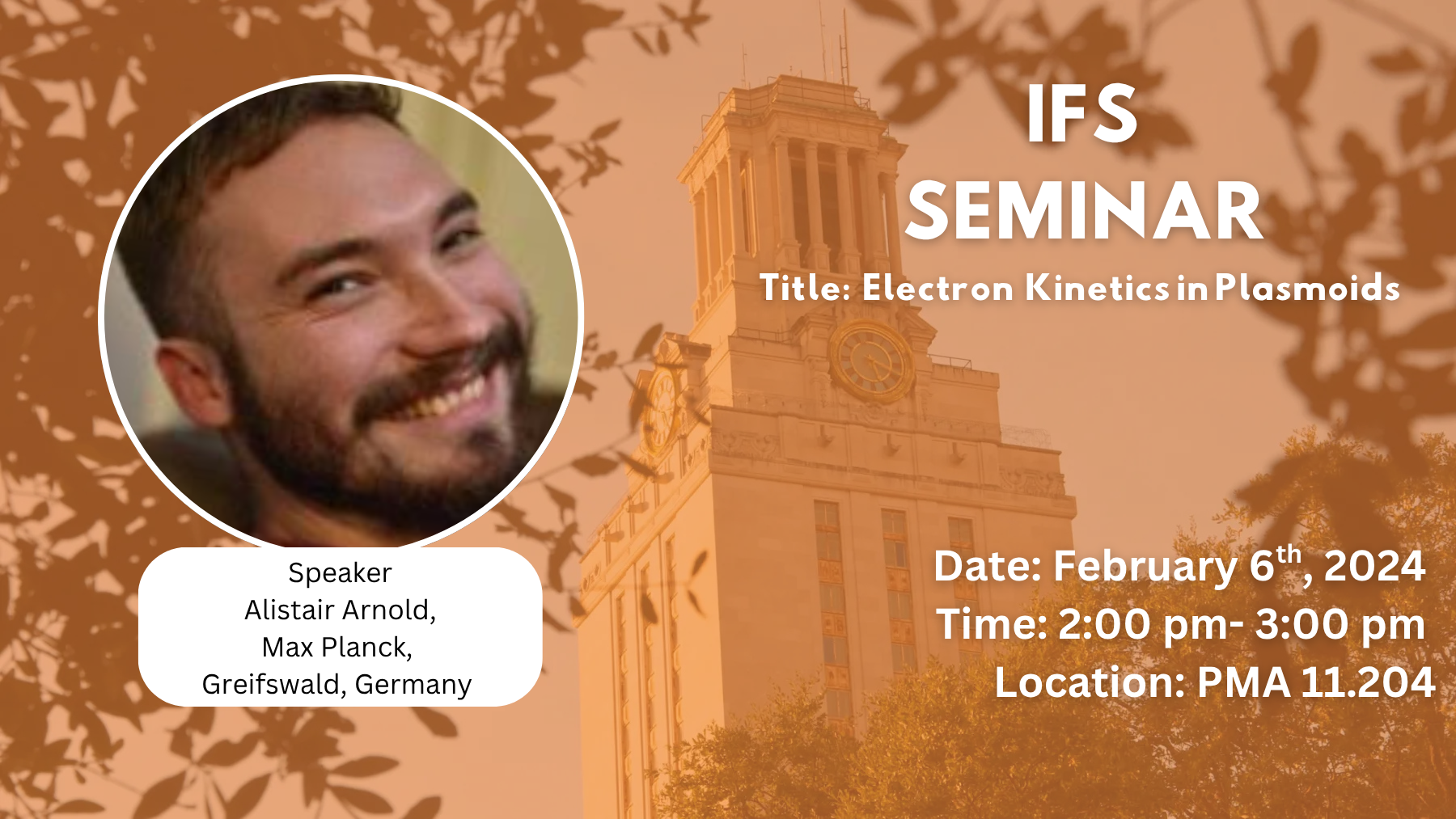
IFS Seminar
Feb
6
2024
Feb
6
2024
Description
Abstract:
Plasmoids are localised regions of high plasma density that arise in both MCF and astrophysical contexts. Owing to the higher thermal mobility of electrons relative to ions, a plasmoid is associated with a localised electric potential that acts to trap electrons. This electric potential also acts to push ions away from the centre of the plasmoid, causing it to expand. As the well expands, energy is extracted adiabatically from trapped electrons – this is the source of energy for the ion flow velocity acquired during expansion. An understanding of electron kinetics in plasmoids is therefore critical in developing an understanding of plasmoid dynamics. Two frameworks for electron kinetics in plasmoid are presented. In the first framework, the electron distribution is assumed to be isotropic and the electron kinetic equation, including the full nonlinear Landau self-collision operator, is integrated exactly over bounce motion and pitch-angle, resulting in a 1D+time equation, the spacial variable being a novel adiabatic invariant.
In the second framework, the electron distribution function is not assumed to be isotropic, but the plasmoid is assumed to be much denser than the ambient plasma. This allows the electron kinetic problem to be reduced to a collisional steady-state with two spacial variables. In both of these frameworks the resulting kinetic equation has only two variables, is amenable to analytical study, and is easy to implement numerically, in stark contrast to the original electron kinetic equation.