
IFS Seminar
Feb
10
2026
Feb
10
2026
Description
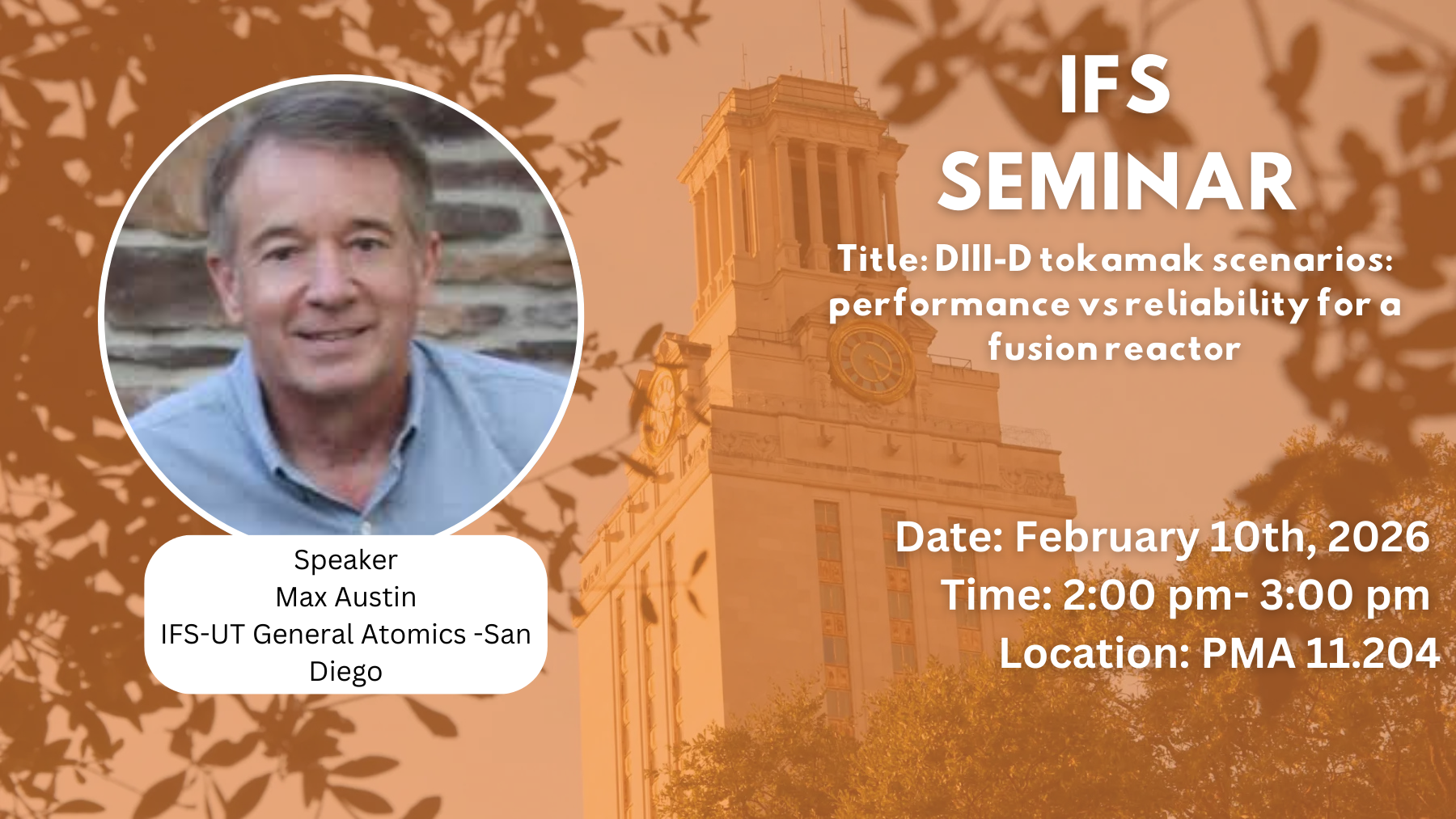
Abstract: The DIII-D tokamak has had a history of developing a wide range of discharge operating regimes or scenarios that are good candidates for tokamak-based fusion reactors. The plasma performance in many of these scenarios is impressive with high confinement factors (H98y2 ~ 2) and high normalized plasma pressure (beta_N ~ 4). However, based on the requirements to make these scenarios work a question arises of their appropriateness for a reactor, due to their inherent challenges for stability, exhaust and reliable long-pulse operation. In a brief, high-level way, a few of these scenarios are compared to the more recently developed negative triangularity (NT) scenario, a regime with high energy confinement but without the liability of edge localized modes typical of the H-mode scenarios that operate in positive triangularity. Other beneficial characteristics are described, such as low impurity accumulation and ability to operate at high Greenwald fraction. Finally, more recent results from the growing database of DIII-D NT discharges will be shown.
Bio: Max Austin received his PhD in Plasma Physics in 1992 from Auburn University. He worked as Visiting Postdoc at General Atomics DIII-D facility for the University of Maryland from 1993-1996. Since 1997 he has been working as a visiting researcher for the University of Texas at Austin at DIII-D, overseeing and leading the UT/DIII-D collaboration grant. His research topics have been primarily in experimental studies of confinement in tokamaks, particularly in the negative triangularity scenario. Additionally, he has managed the operation and enhancement of electron cyclotron emission (ECE) diagnostics in magnetic confinement devices.