
IFS Seminar
May
26
2026
May
26
2026
Description
Abstract:
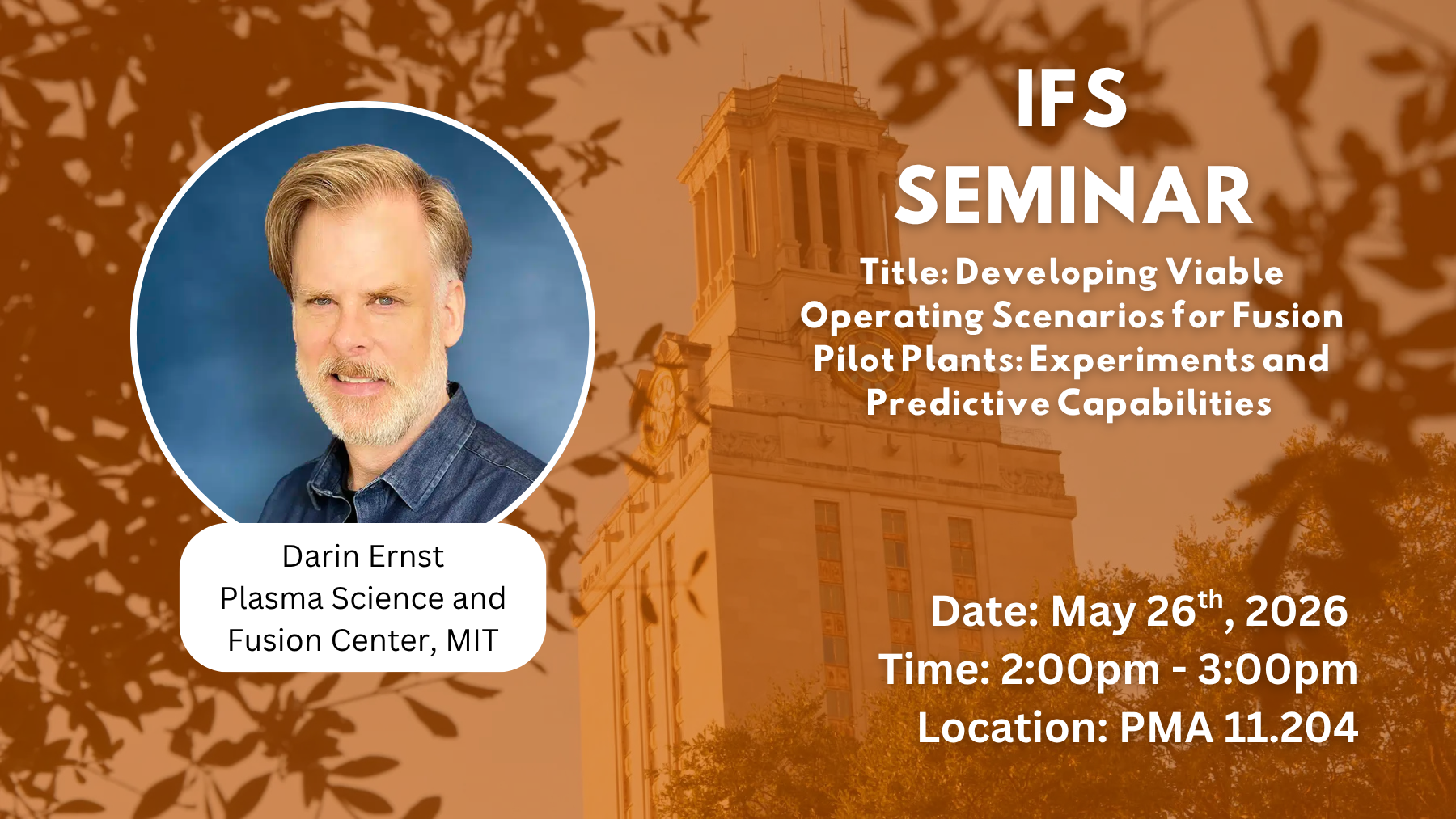
As the fusion program moves toward pilot plants, we must change the way we operate to achieve viable burning plasmas in next-generation fusion devices. Major challenges must be overcome to avoid machine damage, wall erosion, and impurity contamination while maintaining high core and edge pedestal temperatures. Typical edge localized mode (ELM) transients would exceed erosion limits. For future high magnetic field tokamaks, empirical scaling predicts an extremely narrow mm-width heat exhaust layer which could stress-crack or melt the divertor. High boundary temperatures result in strong sputtering of metallic impurities, which in the absence of ELMs to flush them, are drawn into the plasma to radiate from the core. On the bright side, but not without new obstacles, scaling arguments (originating at IFS) suggest that turbulent transport will be much stronger in future edge pedestals. This implies naturally ELM-stable scenarios, which must operate at low collisionalities without impurity accumulation. Our experimental work aims to meet these challenges by developing future-relevant ELM-stable scenarios such as Quiescent H-Mode in DIII-D. Highlights include doubling the divertor heat flux layer width by turbulence, matched by XGC gyrokinetic simulations1 (recently achieving widths up to 8 times empirical scaling); discovery and validation of the nonlinear upshift of the trapped electron mode (TEM) critical density gradient; sustainment of Wide Pedestal QH-Mode with dominant RF heating and improved confinement; controlling impurities including tungsten without ELMs; and demonstrating the absence of an isotope effect on confinement. For compatibility with metal walls, we have recently achieved record densities via strong shaping, enabling the first divertor plasma detachment in QH-mode, while reducing impurity influxes by tailoring edge pedestal profiles.
Fusion performance is highly sensitive to the edge pressure, and if limited by turbulence per the above, exposes a major gap in edge predictive capabilities. The second part of the talk will describe our efforts to develop first-principles predictive capability for turbulent and neoclassical transport in the challenging edge pedestal and boundary region. Our goal has been to develop accurate gyrokinetic turbulence and drift kinetic neoclassical codes, made practical via fast, innovative methods, as well as reduced models. For example, we have formulated and implemented the first gyrokinetic exact Landau collision operator, now released in the GENE code.2 Our global pedestal neoclassical drift-kinetic code features full linearized Fokker-Planck collisions and runs in minutes. We have developed a new multi-scale GPU-based gyrofluid code to simulate coupled toroidal ion and electron scale turbulence, including cross-scale interactions and a realistic zonal flow response. Multiscale simulations can be run orders of magnitude faster than gyrokinetic codes, while matching their results for ion scales. Our larger effort to close this gap in prediction – the FIRE Collaboratory, APP-FPP: Advanced Profile Prediction for Fusion Pilot Plants – is developing accelerated high-fidelity, whole-device predictions of density, temperature & impurity profiles for tokamak and stellarator fusion pilot plants, including gyrokinetic turbulence, kinetic plasma-wall interactions and atomic physics via high-performance computing and AI/ML techniques.
1 D. R. Ernst et al., Broadening of the divertor heat flux profile in high confinement tokamak fusion plasmas with edge pedestals limited by turbulence in DIII-D, Physical Review Letters 132, 235102 (2024).
2 Q. Pan, D. R. Ernst, and D. Hatch, Importance of Gyrokinetic Exact Fokker–Planck Collisions in Fusion Plasma Turbulence, Physical Review E Letters 103, L051202 (2021).
Bio:
Darin received his B.S. from the University of Wisconsin, triple-majoring in Electrical Engineering, Physics, and Math, and was one of 30 members of the Chancellor’s Men’s Honorary. He then received a Ph.D. in Physics from MIT. As an MIT student, he played a significant role in the TFTR D-T campaign during several years at PPPL. This led to his Ph.D. Thesis, which developed a model for TFTR supershots, explaining the D-T isotope effect and other disparate observations, receiving the APS Rosenbluth Award for Outstanding Doctoral Thesis. After a postdoc at PPPL, Darin moved back to MIT as a Research Scientist in the PSFC Plasma Theory Group. There he co-developed a series of PSFC parallel computing clusters, and since 2007 has been the MIT Principal Investigator for gyrokinetic SciDAC projects, supervising four theory postdocs and several students in the development of gyrokinetic, gyro-fluid, and neoclassical codes. After leading experiments on Alcator C-Mod focused on trapped electron mode turbulence, in 2013 he began collaborating on the DIII-D National Fusion Facility, leading 14 DIII-D experiments to date, mainly to develop QH-Mode scenarios. Darin has been active in the community, where he led the 2022 DOE Joint Research Target to develop high performance non-ELMing operating regimes, and is leading a similar large ITPEA IOS joint effort, as well as the QH-Mode subgroup of the EU-US Joint Working Group on ELM-free operating regimes. Most recently, Darin established and leads the 11-institution FIRE Collaboratory, APP-FPP: Advanced Profile Prediction for Fusion Pilot Plants (where IFS researchers play a major role). He has presented 32 invited talks at international conferences and published over 100 refereed articles.