
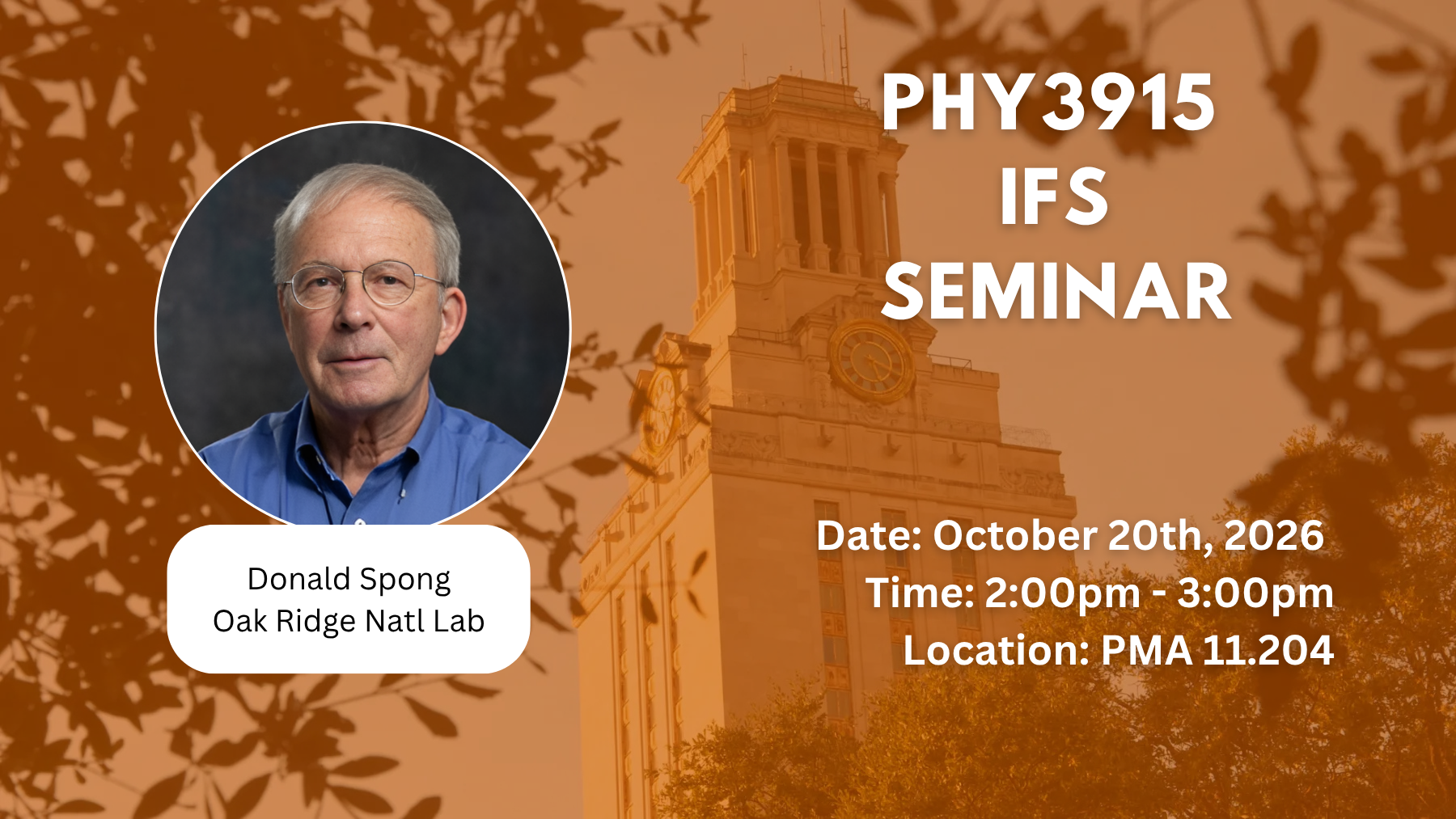
IFS Seminar with Donald Spong
Oct
20
2026
Oct
20
2026
Description
Abstract: Significant improvements have been made in the classical guiding center energetic particle confinement of stellarators via shape optimization. However, as has been observed with tokamaks, the confinement properties of energetic particle (EP) populations may be more dominated by instability-induced transport phenomena than by neoclassical losses. In particular, the various Alfvén eigenmodes (AE) that can be resonantly destabilized by EP components provide channels for enhanced transport of EPs. Stellarators offer the possibility to operate at high density regimes where the slowing-down time is decreased, resulting in lower drives for EP instabilities. This effect has been analyzed for a reactor-sized quasi-helical stellarator, Wistell-D, through evaluating linear stability along constant fusion power contours in electron density and temperature space for the n = 1, 2, and 3 mode families. This work is extended into the nonlinear regime via simulations of the Wistell-D and a reactor scaled version of W7-X. Zonal flow/current generation and mild flattening of the EP density profile are observed from which global EP particle and energy fluxes are derived. The flux-gradient relations exhibit non-local characteristics, as has been seen in applications of FAR3d to tokamaks, and motivates going beyond the usual diffusive and critical gradient models.