
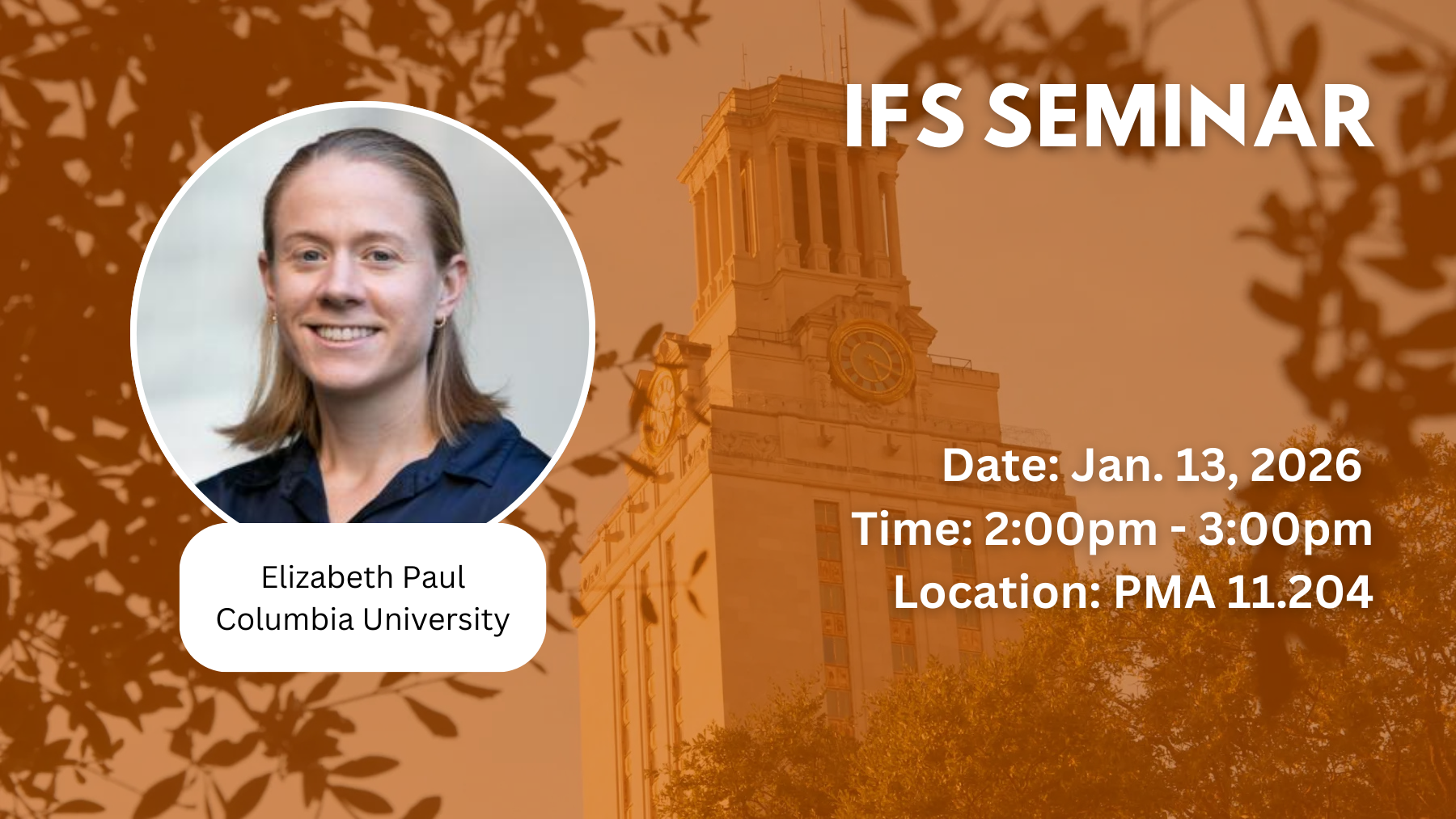
IFS Seminar with Elizabeth Paul
Event starts on this day
Jan
13
2026
Featured Speaker(s):
Elizabeth Paul
Event starts on this day
Jan
13
2026
Title: Reduced models for energetic particle transport in 3D magnetic fields
Description
Abstract: Although collisionless guiding center trajectories are generally non-integrable in 3D magnetic fields, stellarators can be designed to have quasisymmetry. Recently, “precisely quasisymmetric” configurations have been obtained through numerical optimization, demonstrating excellent confinement of the guiding center trajectories of fusion-born alpha particles. There is, however, the potential for enhanced alpha losses due to resonant wave-particle interactions with Alfvén eigenmodes (AEs). Additional AE physics is introduced in moving from axisymmetric to 3D fields, as complex orbit types and continuum structures arise. We present pathways to model and optimize the alpha transport driven by Alfvénic instabilities in stellarators. Analysis of EP resonances and their impact on saturation mechanisms indicate key departures from the AE-driven transport in tokamaks, such as the avoidance of phase-space island overlap in quasihelical configurations. Phase space structure and stochasticity in 3D systems are visualized with novel diagnostic techniques. Finally, we demonstrate a strategy to avoid alpha resonances by manipulating the continuum gap structure.
Bio:
Elizabeth Paul joined the Applied Physics faculty at Columbia University in 2023 as an Assistant Professor. Prior to joining Columbia University, Dr. Paul was a Presidential Postdoctoral Research Fellow at Princeton University. Dr. Paul received her AB in Astrophysical Sciences with concentrations in Applied and Computational Mathematics and Applications of Computing from Princeton University in 2015. In 2020 she received her PhD in Physics from the University of Maryland, College Park. In 2021 Dr. Paul received the Marshall N. Rosenbluth Award from the American Physical Society in recognition of her doctoral work, “For pioneering the development of adjoint methods and application of shape calculus for fusion plasmas, enabling a new derivative-based method of stellarator design.”