
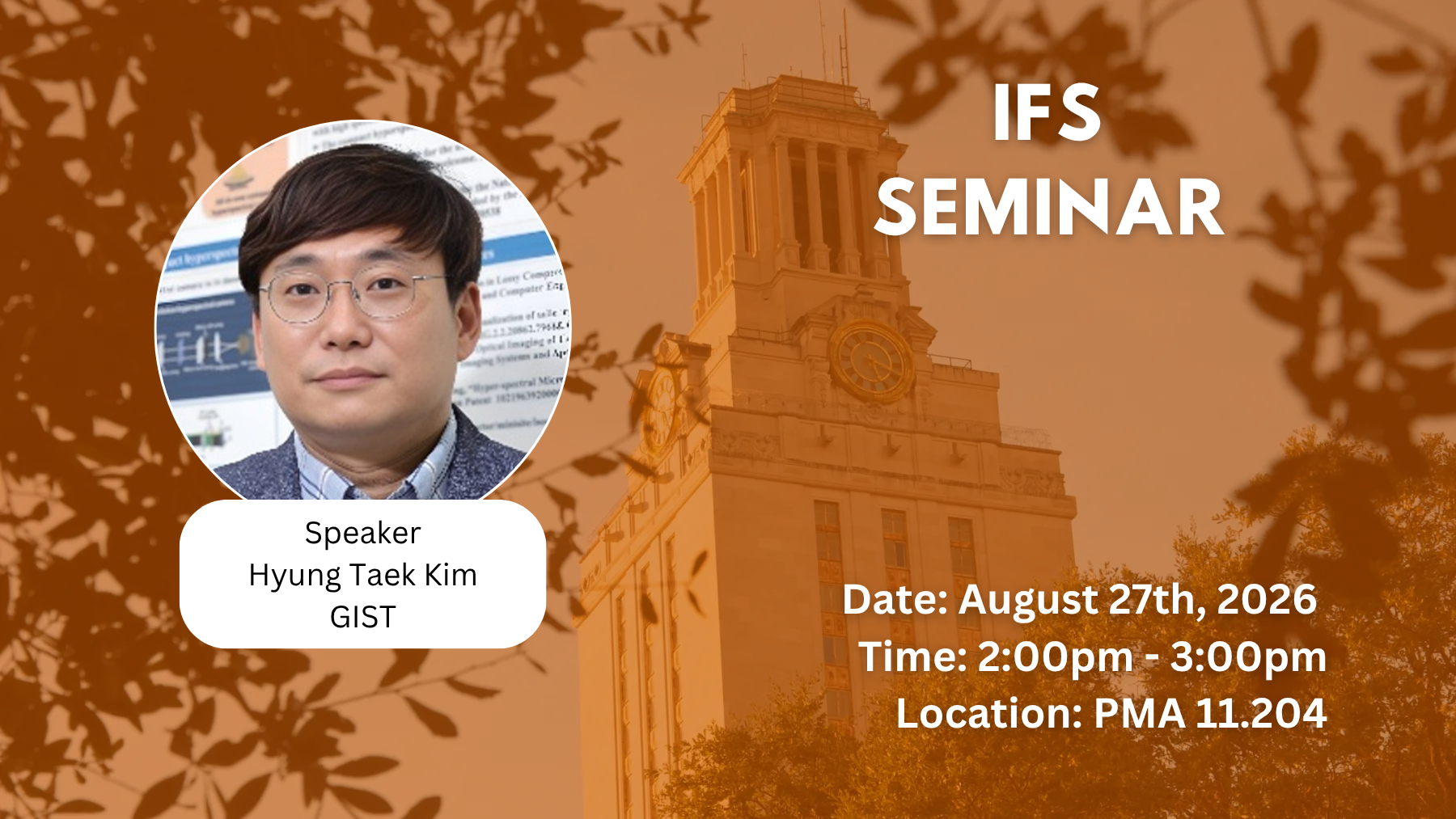
IFS Seminar with Hyung Taek Kim
Event starts on this day
Aug
27
2026
Featured Speaker(s):
Hyung Taek Kim
Event starts on this day
Aug
27
2026
Title: Laser Wakefield Electron Acceleration and Gamma-Ray Generation with Multi-Petawatt Laser Pulses
Abstract
Recent advances in multi-petawatt laser technologies [1] have enabled compact acceleration of multi-GeV electron beams and the generation of ultrashort, high-energy photon pulses. Laser wakefield acceleration (LWFA) provides accelerating fields far stronger than those of conventional radio-frequency accelerators, allowing relativistic electrons to reach multi-GeV energies over centimeter-scale distances [2–3]. The transverse oscillation of these electrons in plasma wakefields also produces femtosecond betatron radiation extending from the X-ray to gamma-ray regime [4].
Using a 4-PW Ti:S laser system [1], we investigated LWFA in a low-density helium gas cell containing 1% neon. Sequential neon ionization enhanced laser-pulse sharpening and self-guiding, while inner-shell ionization induced localized electron injection. This scheme generated high-quality electron beams with energies up to approximately 4.5 GeV. Compared with pure helium, neon doping improved the electron energy, energy spread, and accelerated charge, demonstrating effective control of multi-GeV LWFA driven by multi-PW laser pulses.
Based on this capability, we realized a hybrid betatron gamma-ray scheme in which electron acceleration and radiation generation were separated. Conventional single-stage betatron generation has competing requirements: low plasma density favors efficient electron acceleration, whereas high density provides stronger transverse focusing and radiation emission. The hybrid accelerator–radiator concept overcomes this limitation by combining a low-density laser-driven accelerator with a short, high-density beam-driven plasma radiator [5].
In the two-stage configuration, a multi-GeV electron beam generated in the gas cell entered a high-density gas jet, where strong transverse plasma fields enhanced betatron oscillations and radiations. This separation allowed the acceleration and radiation stages to be independently optimized. The resulting spectrum showed a critical photon energy about 0.4 MeV and a photon yield exceeding 10¹⁰ photons per shot. The peak brilliance was approximately 5×10²⁴ photons·s⁻¹·mm⁻²· mrad⁻²·0.1% BW at 150 keV. Radiographic imaging of a dense metallic object demonstrated sub-100-μm feature resolution, while particle-in-cell simulations confirmed efficient conversion of electron-beam energy into high-energy betatron photons. Additionally, recent results on high-energy gamma-ray generation by nonlinear Compton scattering at CoReLS will be presented.
These results establish multi-PW laser systems as a versatile platform for multi-GeV electron acceleration and high-brightness betatron gamma-ray generation. The independently optimized accelerator–radiator scheme provides a scalable route toward higher photon energies, fluxes, and stability, with applications in dense-object imaging, ultrafast high-energy-density plasma diagnostics, nonlinear Compton scattering, radiation reaction, and strong-field quantum electrodynamics [6].
References
[1] J. H. Sung, H. W. Lee, J. Y. Yoo, et al., Opt. Lett. 42, 2058 (2017).
[2] T. Tajima and J. M. Dawson, Phys. Rev. Lett. 43, 267 (1979).
[3] H. T. Kim, K. H. Pae, H. J. Cha, et al., Phys. Rev. Lett. 111, 165002 (2013).
[4] S. Corde, K. Ta Phuoc, G. Lambert, et al., Rev. Mod. Phys. 85, 1–48 (2013).
[5] J. Ferri, S. Corde, A. Döpp, et al., Phys. Rev. Lett. 120, 254802 (2018).
[6] M. Mirzaie, C. I. Hojbota, D. Y. Kim, et al., Nat. Photonics 18, 1212–1217 (2024).