
IFS Seminar with Michael Fitzgerald
Aug
11
2026
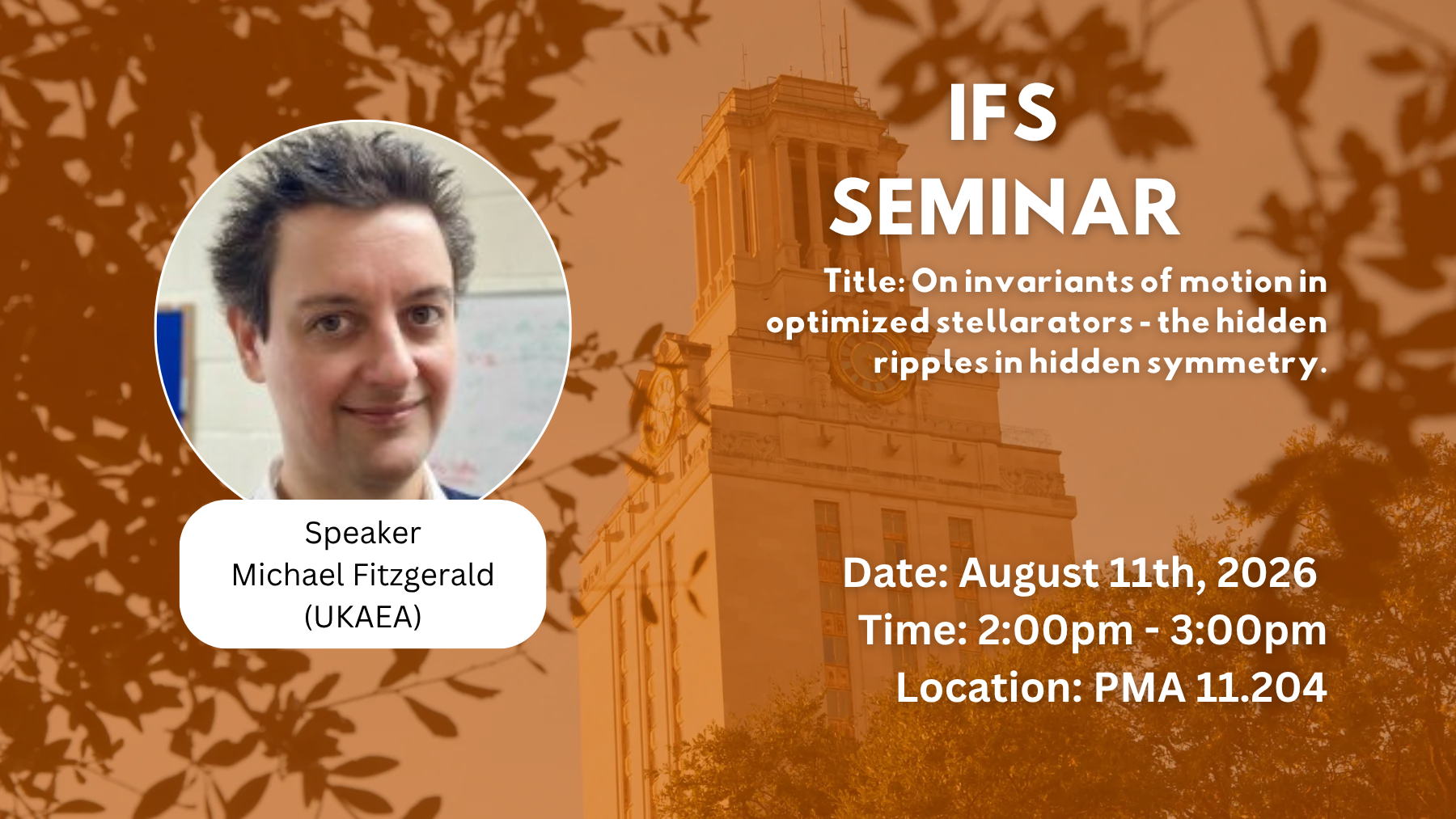
Title: On invariants of motion in optimized stellarators - the hidden ripples in hidden symmetry.
Aug
11
2026
Description
It has long been understood that alpha particle equilibrium in tokamaks relies on the existence of approximate symmetries in time, gyroangle and toroidal angle. These symmetries lead to invariants, and invariants lead to an integrable Hamiltonian system for the guiding center motion and ultimately alpha confinement. The toroidal symmetry is of particular interest because it encodes the average magnetic flux surface where a particle may be found.
The Taylor Hamiltonian governing guiding centre motion depends on the magnetic field B only through the modulus. Stellarators have many attractive features for a fusion reactor, and recent work on quasi-symmetry demonstrates magnetic equilibria with “hidden symmetry” in the modulus of B for an appropriate choice of angle and accompanying claims for the equivalence (or better!) for tokamak alpha particle confinement.
Quasi-symmetry is, however, not the end of the story, as one wishes to confine particles that gyrate. One can show that the difference between guiding-center and full-orbit Hamiltonian representations may be treated as a fictional magnetic ripple, and the usual machinery of wave-particle resonance physics may be deployed to help predict the effects of finite Larmor radius. A crucial element of this hidden ripple relates to the magnetic field torsion asymmetry which cannot be optimized away and traps resonant orbits. This “hidden ripple” sets an important lower bound for acceptable magnetic field in a quasi-symmetric stellarator that confines alpha particles.