
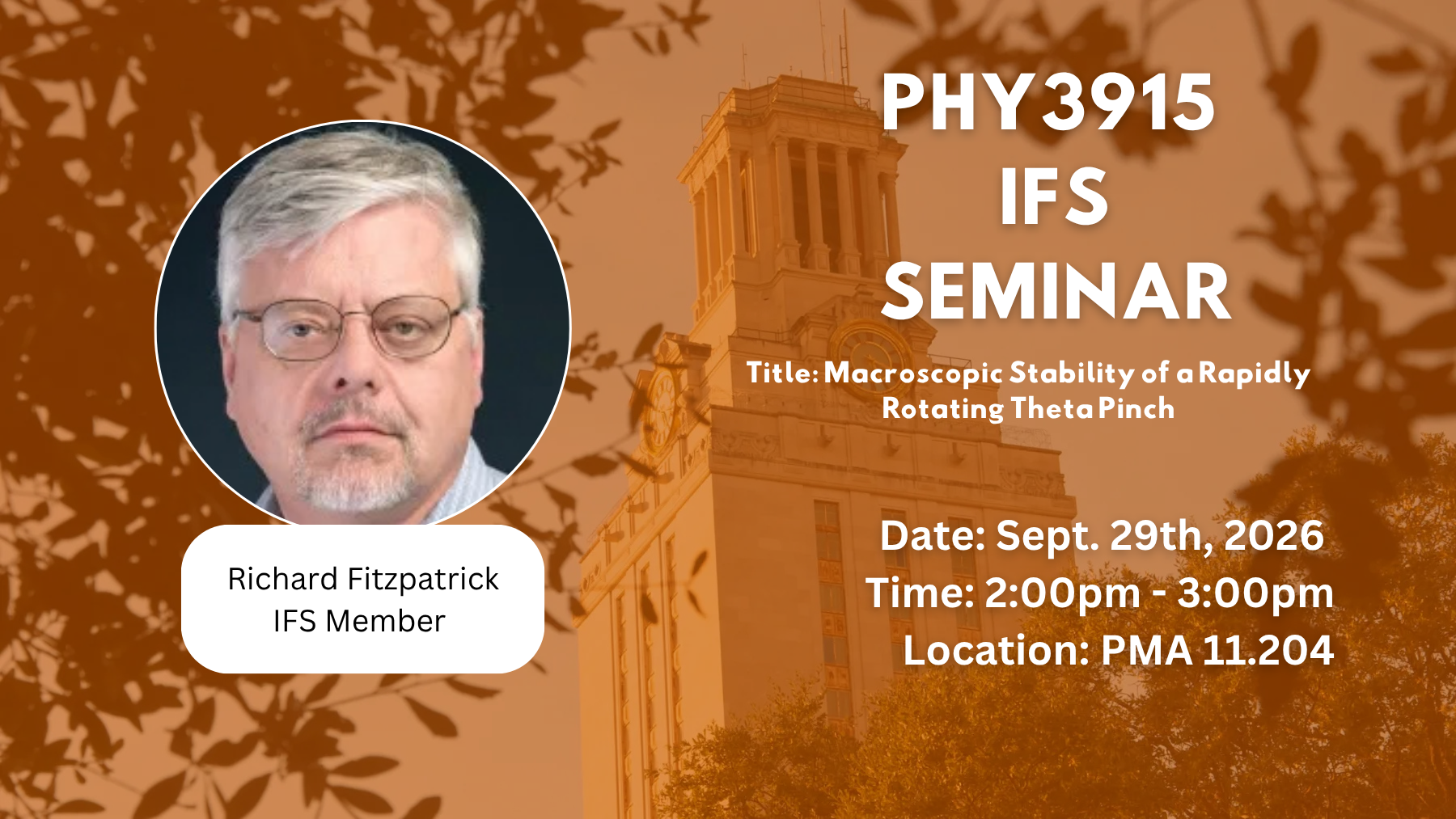
IFS Seminar with Richard Fitzpatrick
Event starts on this day
Sep
29
2026
Featured Speaker(s):
Richard Fitzpatrick
Event starts on this day
Sep
29
2026
Macroscopic Stability of a Rapidly Rotating Theta Pinch
Description
Macroscopic Stability of a Rapidly Rotating Theta Pinch
Magnetic mirrors are among the simplest magnetic confinement devices employed in nuclear fusion research. Recently, renewed interest in mirror devices has accompanied the development of strong HTS magnets, which has enabled the construction of compact
mirror devices possessing very high mirror ratios. Furthermore, the confinement properties of a magnetic mirror can be greatly enhanced via rapid (i.e., sonic) levels of plasma rotation. The question remains, however, whether such a device would be stable.
In this talk, I will describe recent work in which the macroscopic ideal-MHD stability of an axisymmetric mirror device with sonic levels of plasma rotation is analyzed by approximating the plasma equilibrium as a rotating theta pinch possessing an artificial gravity. The plasma is found to be stable provided that it is sufficiently short in the axial direction. The critical axial length of the device below which the MHD modes are stabilized
first decreases with increasing plasma rotation, attains a minimum value when the rotation is roughly sonic, and then increases with increasing plasma rotation. Moreover, the value of the plasma rotation off the magnetic axis is found to have a significantly stronger effect on the stability of the modes than the value on the magnetic axis.
first decreases with increasing plasma rotation, attains a minimum value when the rotation is roughly sonic, and then increases with increasing plasma rotation. Moreover, the value of the plasma rotation off the magnetic axis is found to have a significantly stronger effect on the stability of the modes than the value on the magnetic axis.
Bio
Richard Fitzpatrick earned a Master's degree in physics from the University of Cambridge, and a D. Phil. in astronomy from the University of Sussex. After working in the UKAEA's Culham Laboratory for seven years, he became a professor of physics at the University of Texas at Austin, where he has been a faculty member since 1994. His research is mostly concerned with the macroscopic stability of fusion plasmas.