
IFS Seminar with Yashika Ghai
Oct
22
2026
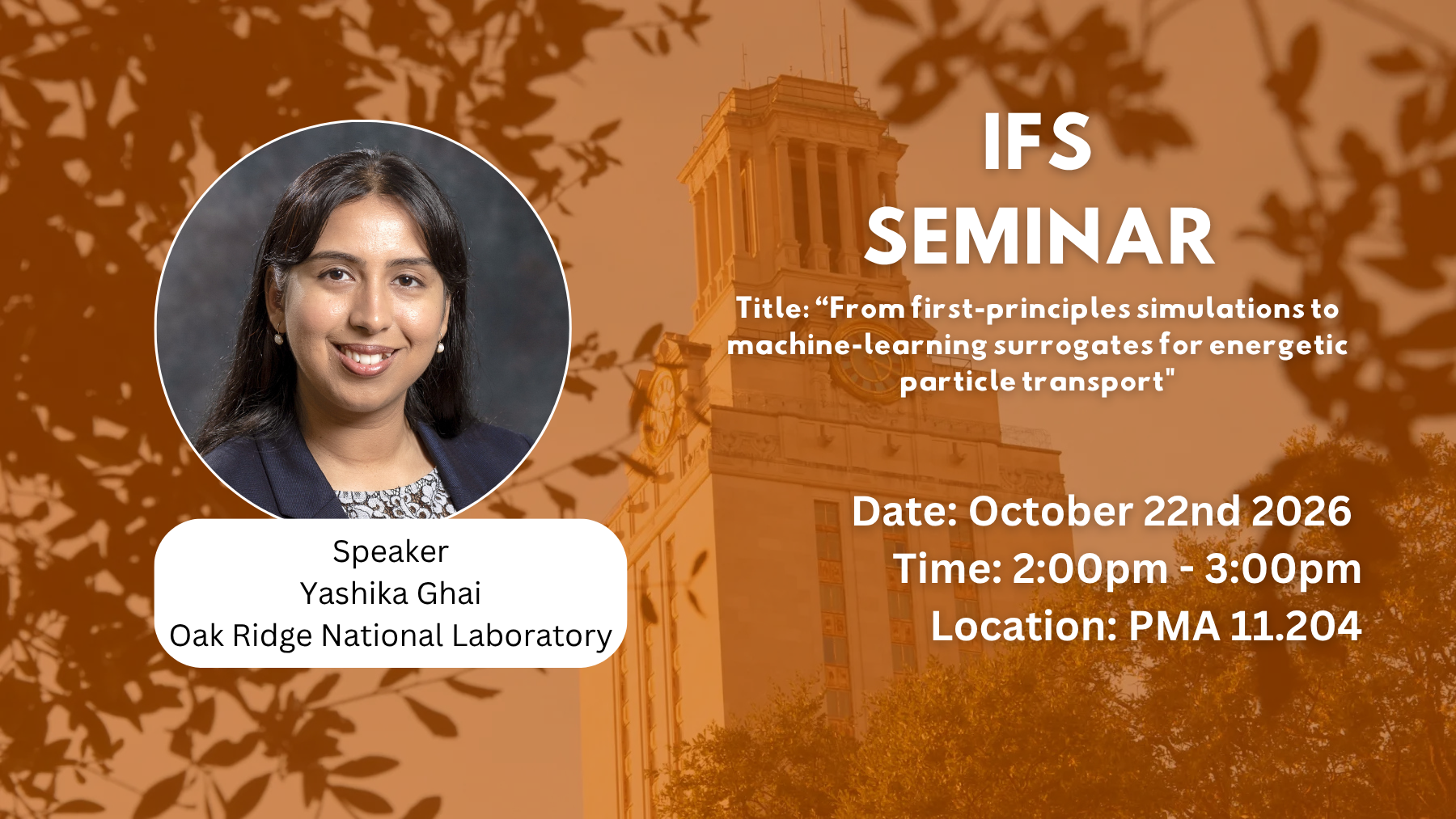
“From first-principles simulations to machine-learning surrogates for energetic particle transport"
Oct
22
2026
Description
Abstract: High-fidelity plasma simulations are indispensable for understanding and designing future fusion reactors, but their high computational cost presents a major challenge for reactor optimization and integrated modeling predictions. This seminar will introduce the concept of surrogate models—fast computational approximations of expensive physics simulations—and discuss their growing role in fusion research. Focusing on energetic particle transport driven by Alfvén eigenmode instabilities in ITER, the talk will present machine-learning-based surrogate models developed using nonlinear FAR3d simulations. Two complementary approaches, Gaussian process regression and neural networks, will be discussed for rapid prediction of energetic beam and alpha-particle transport together with predictive uncertainty estimates. The resulting surrogate models reproduce nonlinear transport with high accuracy while reducing computational cost
Bio: Yashika Ghai is an R&D Staff Scientist in Fusion Energy Division at the Oak Ridge National Laboratory (ORNL). She is an expert in fundamental plasma physics and high-performance computing (HPC) and currently investigates the behavior of energetic particles in fusion plasma environments such as neutral beam-injected high-energy deuterium ions, fusion-born alphas, and runaway electrons produced during disruptions. She is an expert on gyro-fluid and particle tracking models to predict energetic particle transport in presence of plasma instabilities. She also works on developing machine learning based surrogate models that calculate alpha particle transport fluxes in the presence of Alfven eigenmodes. Such models are needed for faster and reasonable accurate predictions of alpha particle transport in integrated workflows for a fusion reactor design and to analyze the impact of alpha transport on its burn performance. A detailed bio can be found here: