
PHY359S IFS Seminar
Event starts on this day
Nov
11
2026
Featured Speaker(s):
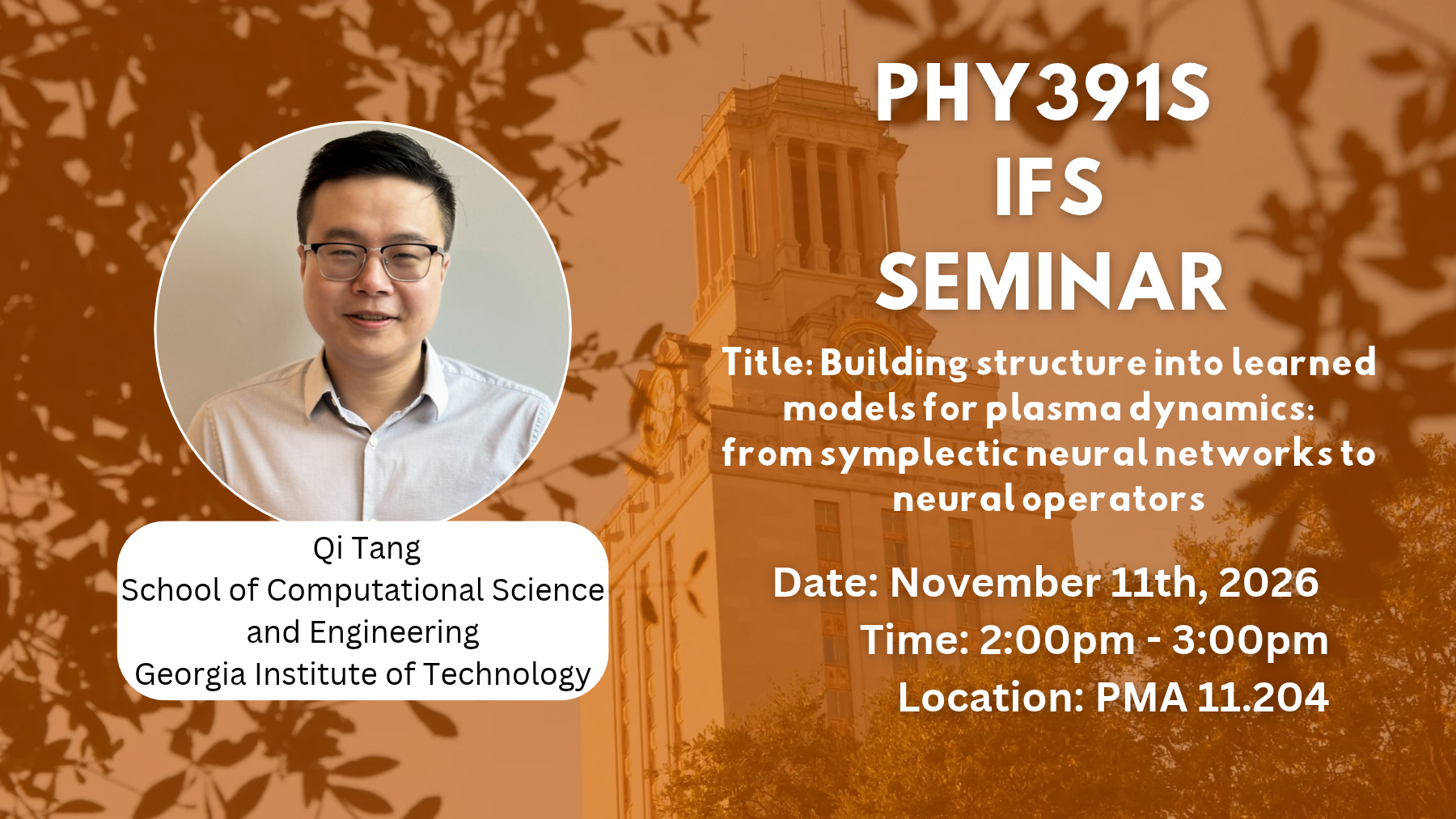
Qi Tang
Event starts on this day
Nov
11
2026
Title: Building structure into learned models for plasma dynamics: from symplectic neural networks to neural operators
Description
ABSTRACT
ML surrogates for plasma simulation are fast but often fail over long times: they drift in energy, break invariants, and smear sharp features. We argue that the remedy is to build the mathematical and physical structure of the dynamics directly into the architecture. We first
present HenonNet and SympMat, neural networks that are symplectic by construction. They learn flux-preserving Poincare maps of toroidal magnetic fields, outperform the Boris pusher below the gyroperiod, and reproduce hot-electron distributions in wave-particle interactions. We then turn to eural
operators whose architecture mirrors the operator structure of the PDE: a local-global operator for ideal MHD that resolves both large-scale flow and sharp features, and SplitNO, which composes learned transport and dissipation subflows for the Vlasov-Poisson-Fokker-Planck system. Both substantially
outperform FNO baselines in long rollouts, maintaining relative errors of 1-2%, while FNO fails in some challenging cases.
BIOGRAPHY
Qi Tang is an Assistant Professor in the School of Computational Science and Engineering at Georgia Tech. His research spans computational plasma physics, structure-preserving numerical methods, high-performance computing, and scientific machine learning. Before joining Georgia
Tech in 2024, he was a Staff Scientist at the Applied Math and Plasma Physics Group in the Theoretical Division at Los Alamos National Laboratory, where he led a multi-institutional DOE SCR project and contributed to FES SciDAC. He received a DOE Early Career award in 2025 and is
an institutional PI of the NSF STC TEMPEST, the DOE ASCR MMICC center CHaRMNET, and two NNSA PSAAP centers. He holds a PhD in Applied Math from Michigan State University and a BS in Math from Zhejiang University.