
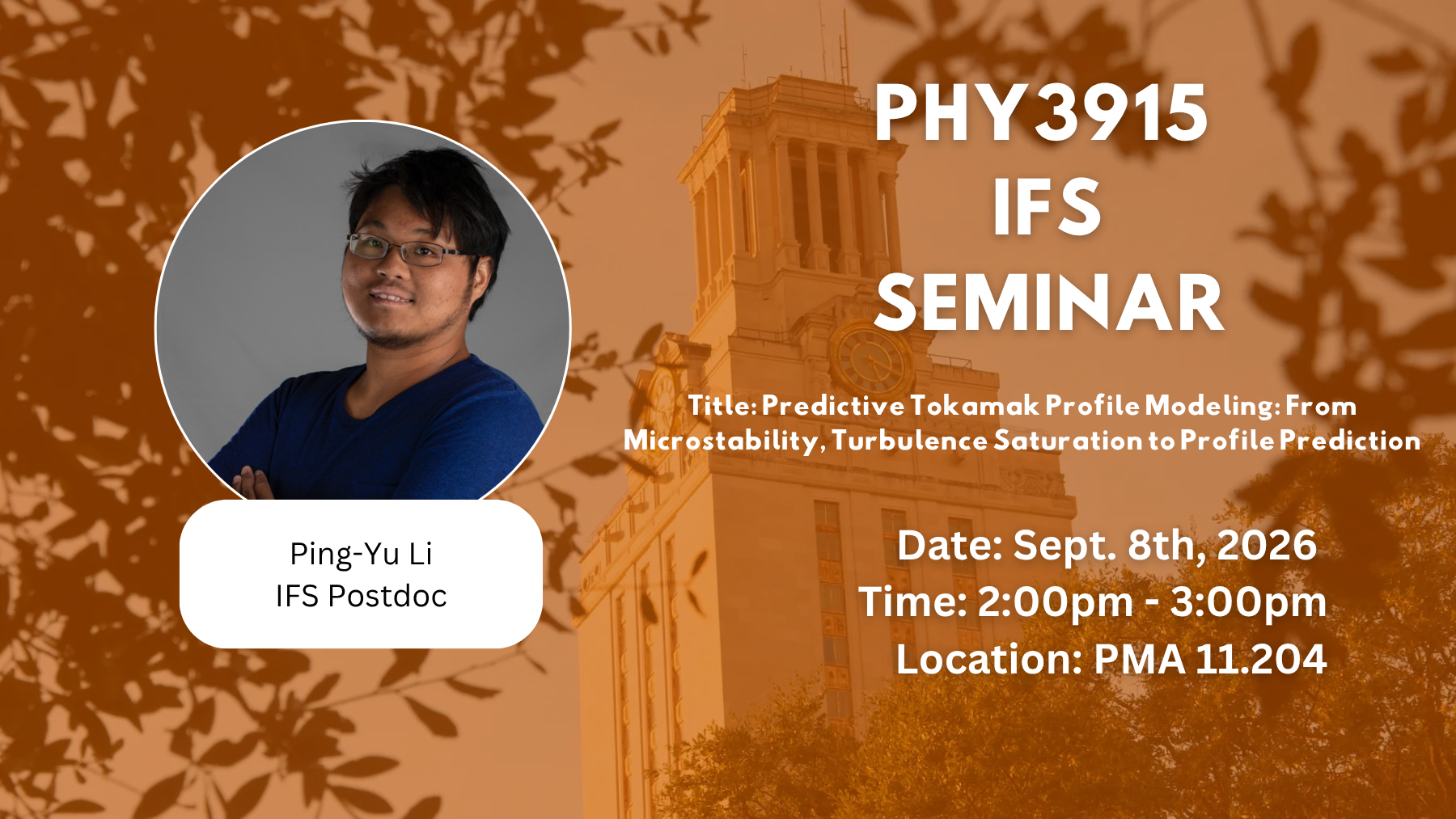
PHY3915 IFS Seminar with Ping-Yu Li
Event starts on this day
Sep
8
2026
Featured Speaker(s):
Ping-Yu Li
Event starts on this day
Sep
8
2026
Title: Predictive Tokamak Profile Modeling: From Microstability, Turbulence Saturation to Profile Prediction
Description
Abstract:
Self-consistent profile evolution is the ultimate benchmark for transport theory, determining whether local turbulent drives, neoclassical channels, and sources dynamically balance to reproduce experimental equilibria. In this seminar, we examine electron temperature gradient (ETG) turbulence and integrated pedestal profile modeling in the high-$\beta$ National Spherical Torus Experiment (NSTX). Using linear and nonlinear gyrokinetic simulations with GENE, we show that the conventional approximation of neglecting compressional magnetic fluctuations ($\delta B_\parallel = 0$) artificially suppresses mid-to-large-scale ETG modes ($k_y\rho_s < 50$); retaining the full electromagnetic response recovers the true physical instability drive and identifies ETG as a critical transport channel in the NSTX pedestal. To represent this transport in integrated profile modeling, we adopt a universal reduced heat flux model for ETG within the ASTRA transport solver. Coupled with neoclassical transport (NCLASS) and a quasilinear kinetic ballooning mode (KBM) limit, this model self-consistently reproduces experimental $T_e$ and $T_i$ pedestal profiles across both ELMy and ELM-free NSTX discharges.
To advance beyond standard mixing-length heuristics, we introduce an analytical gyrokinetic saturation theory grounded in nonlinear triplet interactions derived from an Eddy-Damped Quasi-Normal Markovian (EDQNM) closure. Benchmarked against local nonlinear GENE simulations across gradient scans, this framework provides a more realistic closure for direct profile prediction codes. Finally, we highlight ongoing work using GENE-X to simulate cross-separatrix turbulence in Alcator C-Mod I-mode, aimed at understanding edge-SOL boundary physics and providing self-consistent boundary conditions for whole-device integrated modeling.
Bio:
Ping-Yu Li is a Postdoctoral Researcher at The University of Texas at Austin . He earned his Ph.D. in Physics and M.A. in Mathematics from the University of Wisconsin–Madison, following a B.S. and M.S. in Physics from National Taiwan University. His research specializes in theoretical and computational plasma physics, focusing on nonlinear gyrokinetic simulations, turbulent transport, and turbulence saturation theory. Dr. Li’s work investigates ion temperature gradient (ITG) and electron temperature gradient (ETG) driven turbulence, mode-coupling saturation dynamics, and predictive pedestal temperature profile modeling in spherical tokamaks such as NSTX and MAST.