
Plasma Physics Tutorials
Event starts on this day
Nov
19
2026
Featured Speaker(s):
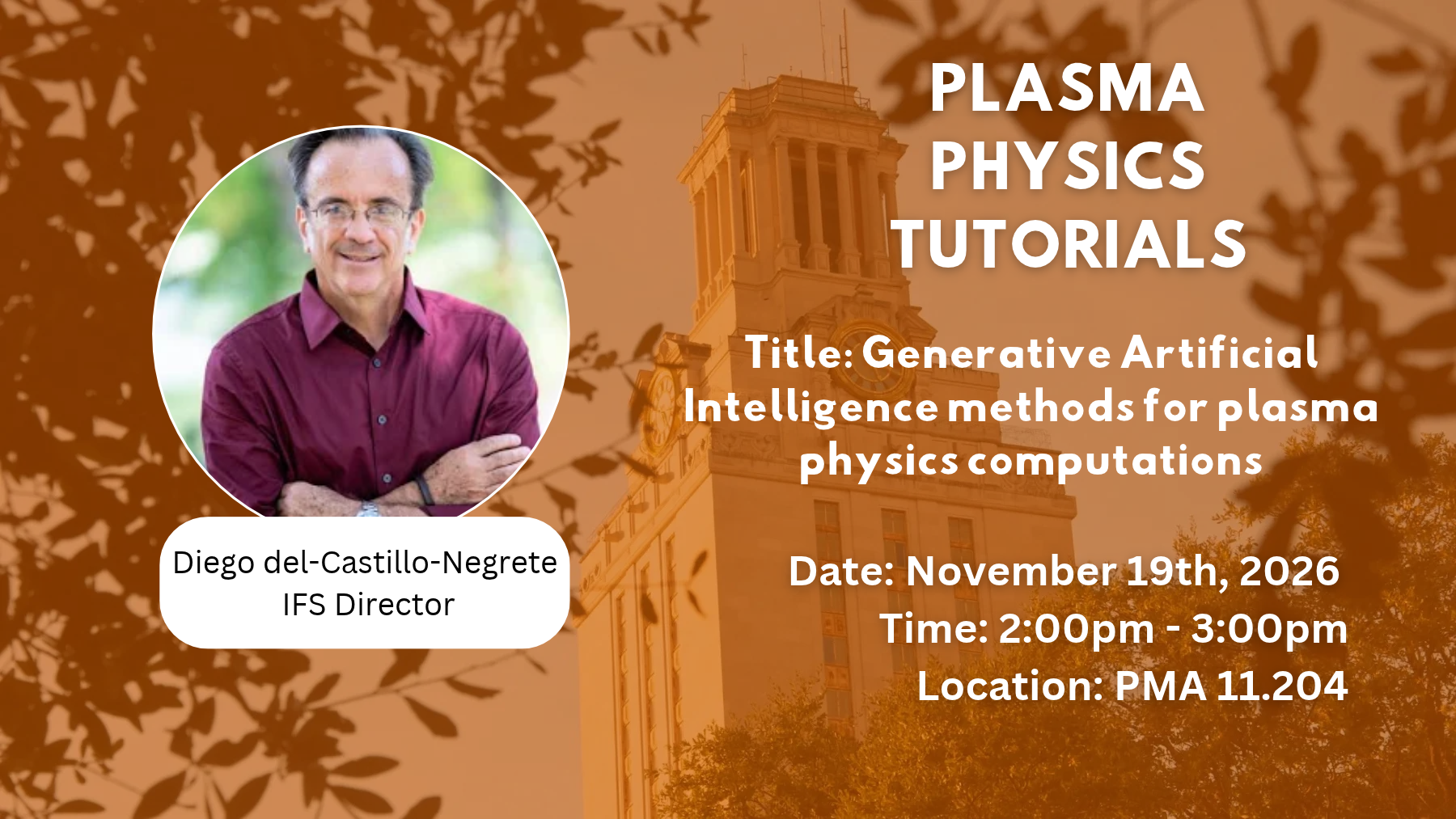
Diego del Castillo Negrete
Event starts on this day
Nov
19
2026
Generative Artificial Intelligence methods for plasma physics computations
Description
Abstract
We review recent progress on generative artificial intelligence (AI) methods to accelerate turbulence simulation and kinetic computations of plasmas of interest to controlled nuclear fusion. These plasmas are far-from-equilibrium, strongly nonlinear systems exhibiting complex spatiotemporal multiscale dynamics that result in formidable computational challenges. For turbulence, we discuss AI frameworks based on the coupling of convolutional variational autoencoders, that encode precomputed turbulence data into a reduced latent space, and recurrent neural networks and decoders that generate new turbulence states. Applications to plasma turbulence fluid models, exhibiting 400X acceleration, and gyrokinetic models are presented. For kinetic problems, we discuss the use of AI methods to accelerate particle-based computations. These computations are time-consuming due to the need to follow large ensembles of particles to avoid statistical sampling errors. The physics models of interest are Fokker-Planck equations for the particle distribution function in phase space. The AI methods include Normalizing Flows and Diffusion Models. Applications include transport in 3D chaotic flows, and runaway electrons in magnetically confined fusion plasmas.
Bio
Diego del-Castillo-Negrete is the director of the Institute for Fusion Studies and Research Professor at the Department of Physics of the University of Texas at Austin. Before joining UT Austin, he was a Distinguished Scientist in the Theory and Modeling Group of the Fusion Energy Division at the Oak Ridge National Laboratory. Previous appointments include work at the Theoretical Division of Los Alamos National Laboratory, and the Scripps Institution of Oceanography at the University of California San Diego. His research interests span a wide spectrum of topics in plasma physics, controlled nuclear fusion, computational physics, applied mathematics, nonlinear dynamics and machine learning.