
Physics Colloquium with Aidan Herderschee
Sep
9
2026
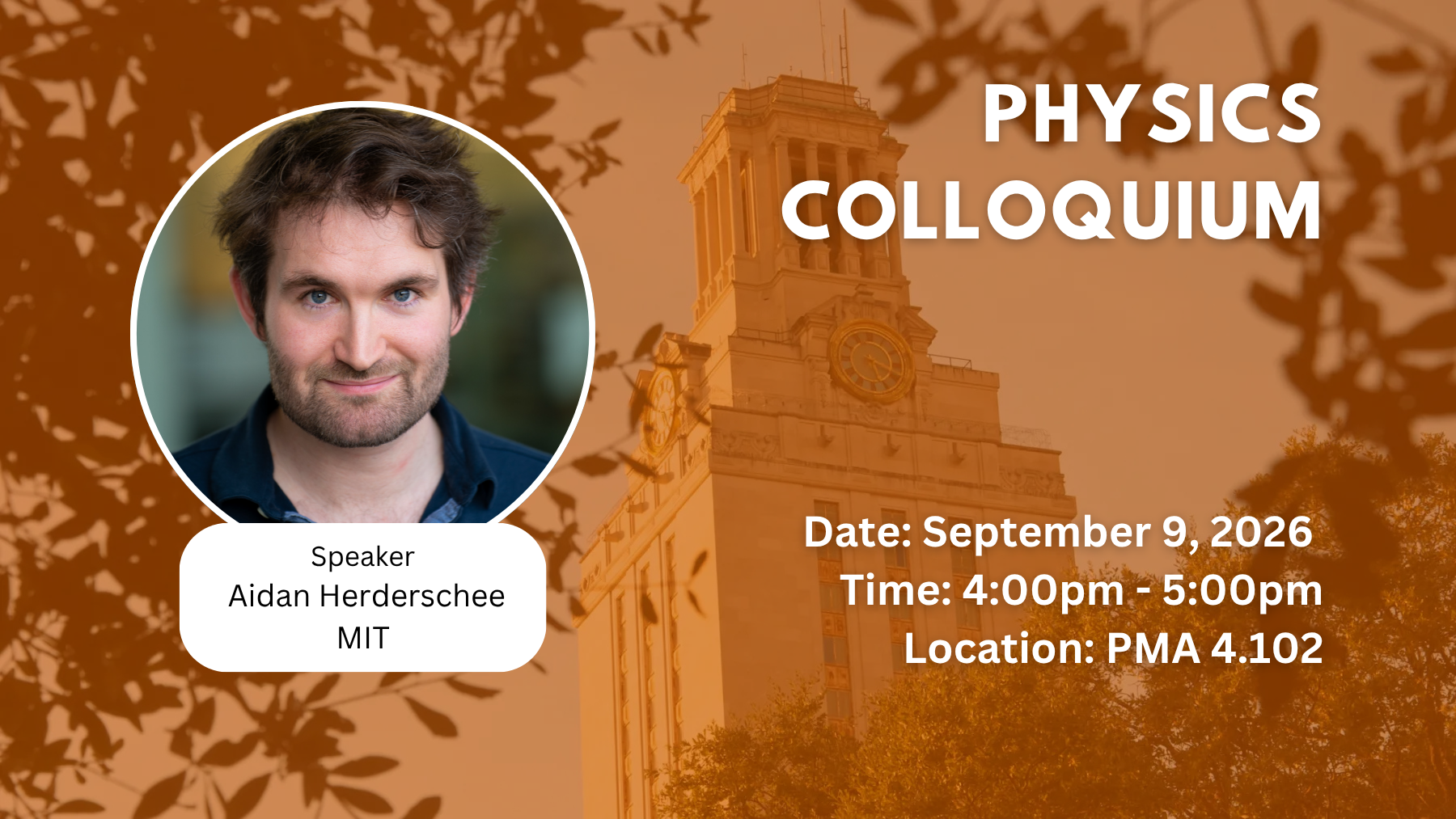
Sep
9
2026
Abstract
General relativity appears to contain structure and predict phenomena that go beyond our current computational and conceptual frameworks. Gravity today may be like electromagnetism before special relativity, when what was missing was not new equations but the right frameworks for understanding them. Experiments can now begin to guide this search as gravity enters a period of unprecedented empirical access. LIGO and the Event Horizon Telescope already observe black holes. LISA will track black holes deep in the strong-field regime. Quantum simulators may be able to realize many-body systems that conjecturally exhibit emergent gravitational dynamics in the strong coupling regime. I build the computational and conceptual frameworks necessary to maximally leverage these experiments. Many tools are necessary for this. This talk focuses on one of them, the scattering amplitudes program, which was originally developed for collider physics. I will give two examples of this philosophy in action. First, I used these methods to compute the gravitational wave emitted when two black holes pass each other at large separation, which could inform future LISA templates. Second, the same methods let us ask which quantum theories of gravity can exist at all. Requiring only self-consistency, we find strong evidence that, in an idealized, weakly coupled, and highly symmetric setting, string theory is the unique extension of general relativity. These bounds provide an avenue for studying strongly coupled many-body systems that are conjectured to exhibit emergent gravitational dynamics. I will close with implications of these results.
Bio
Aidan Herderschee is a postdoctoral researcher at MIT. He received his PhD from the niversity of Michigan and was previously a postdoctoral fellow at the Institute for Advanced Study. His research focuses on fundamental questions about quantum gravity. Using holography, he studies black holes and the quantum nature of spacetime. He also develops new theoretical tools, drawing on scattering amplitudes, to connect these ideas to experimental observations of black holes and the early universe, and to bring aspects f quantum gravity within reach of quantum simulation.
Location
PMA 4.102 (Wheeler Auditorium)