
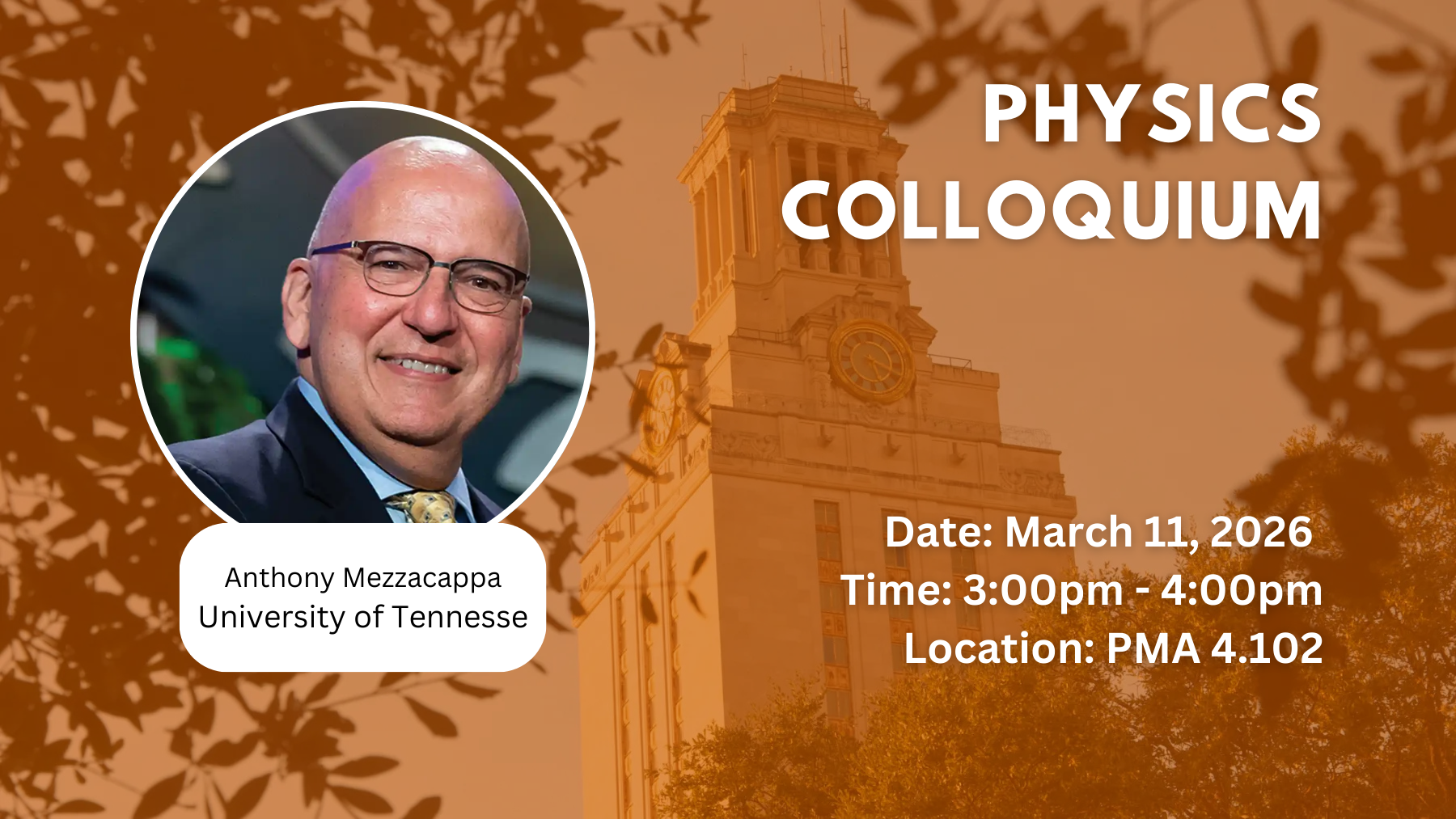
Physics Colloquium with Anthony Mezzacappa
Mar
11
2026
Description
Abstract: Core collapse supernovae are the explosive deaths of massive stars of approximately ten Solar masses or greater. They are directly or indirectly responsible for the production of the lion’s share of the elements in the periodic table. More specifically, they are the sole cosmic source of oxygen. The human body is by weight approximately two thirds oxygen, and we know that we need oxygen to live. Therefore, there is no cosmic source of the elements more important to the origin of human life. Human life is made possible through the deaths of massive stars in a veritable cosmic circle of life. Core collapse supernovae are multidimensional, multi-physics events. Efforts to ascertain the central engine driving them are necessarily based on simulations, the first of which was conducted six decades ago. Much has been learned in the sixty years since, especially in the last ten years when progress has been exponential, owing to the advent of sophisticated three-dimensional simulations enabled by leadership-class computing platforms. I will motivate the study of core collapse supernovae, discuss the physics of their central engine as we understand it today, and discuss current gaps and uncertainties in our simulation efforts and plans to address them in the future.
Bio: Dr. Mezzacappa is the Newton W. and Wilma C. Thomas Chair in Theoretical and Computational Astrophysics and the College of Arts and Sciences Excellence Professor, in the Department of Physics and Astronomy at the University of Tennessee, Knoxville. He served as the Director of the Joint Institute for Computational Sciences, joint between the University of Tennessee and its six UT-Battelle partner universities and the Oak Ridge National Laboratory, from 2012 to 2019. Prior to joining the University of Tennessee, Dr. Mezzacappa was a Corporate Fellow at the Oak Ridge National Laboratory, Group Leader for Theoretical Physics in its Physics Division, Group Leader for Computational Astrophysics in its Computer Science and Mathematics Division, and had been on staff at ORNL since 1996, where he created one of the leading core collapse supernova theory programs in the world, and the largest. Dr. Mezzacappa held postdoctoral appointments at the University of Pennsylvania and the University of North Carolina at Chapel Hill before joining ORNL. He completed his B.S. degree in physics at M.I.T. in 1980, and his Ph.D. in physics at the Center for Relativity at the University of Texas at Austin in 1988, one of the leading centers for the study of relativity and its astrophysical applications in the world. He has worked in the areas of astrophysics and cosmology and specializes in the theory of core collapse supernovae and in the development of computational methods and simulation frameworks for simulations of such supernovae on leadership-class supercomputing platforms.