
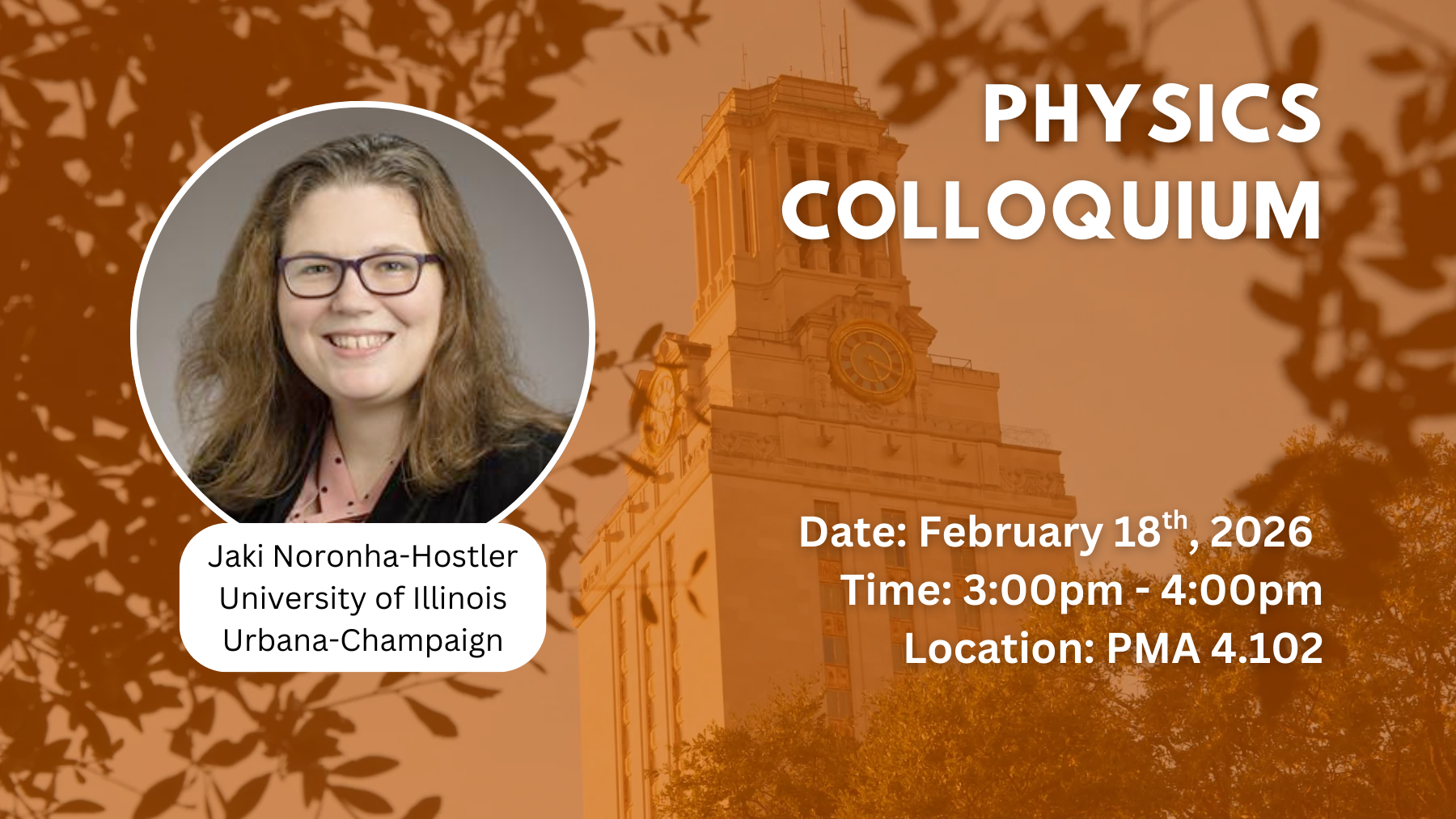
Physics Colloquium with Jaki Noronha-Hostler
Feb
18
2026
Feb
18
2026
Description
Abstract: The strongest force in nature binds quarks and gluons into hadrons, confining them under ordinary conditions. Collisions of heavy nuclei at the Relativistic Heavy Ion Collider (RHIC), now in its 25th year, momentarily liberate these constituents into the quark–gluon plasma—a short-lived droplet of Quantum Chromodynamics (QCD) matter that flows with nearly perfect fluidity. These discoveries have pushed our understanding of relativistic fluids to its limits, driving theoretical developments with far-reaching consequences. Precision measurements of collective flow and fluctuations at RHIC reveal the transport properties of this fluid and allow us to reconstruct the initial state of the collision, providing insights into many-body QCD at extreme energies. The RHIC Beam Energy Scan has opened rare experimental access to the QCD phase diagram at high baryon density, including possible signatures of a critical point with implications for neutron-star matter. Open questions remain—such as how quarks and gluons reconstitute into hadrons and whether a new state of dense gluonic matter exists—that will be probed by the next-generation Electron–Ion Collider.
Bio: Jacquelyn (Jaki) Noronha-Hostler is an Associate Professor of Physics at the University of Illinois Urbana-Champaign, where she has been since 2019. Prior to Illinois, she was an Assistant Professor at Rutgers University in 2017. She earned her Ph.D. in theoretical physics from Goethe-Universität Frankfurt, where she worked on the properties of hot and dense strongly interacting matter. Following her Ph.D., she held postdoctoral appointments at the University of São Paulo, Columbia University, and the University of Houston. She has served on the American Physical Society's Division of Nuclear Physics Executive Committee and holds leadership roles in large multi-institutional collaborations, serving on the Steering Committee of the DOE SURGE Topical Collaboration and on the Executive Committee of the NSF-funded MUSES Collaboration. Her research focuses on the theory of strongly interacting matter, relativistic hydrodynamic simulations, and QCD-based frameworks to connect heavy-ion collision experiments with the properties of dense matter relevant to neutron stars.
Location
PMA 4.102 (Wheeler Auditorium)