
Physics Colloquium with Marco Polini
Oct
14
2026
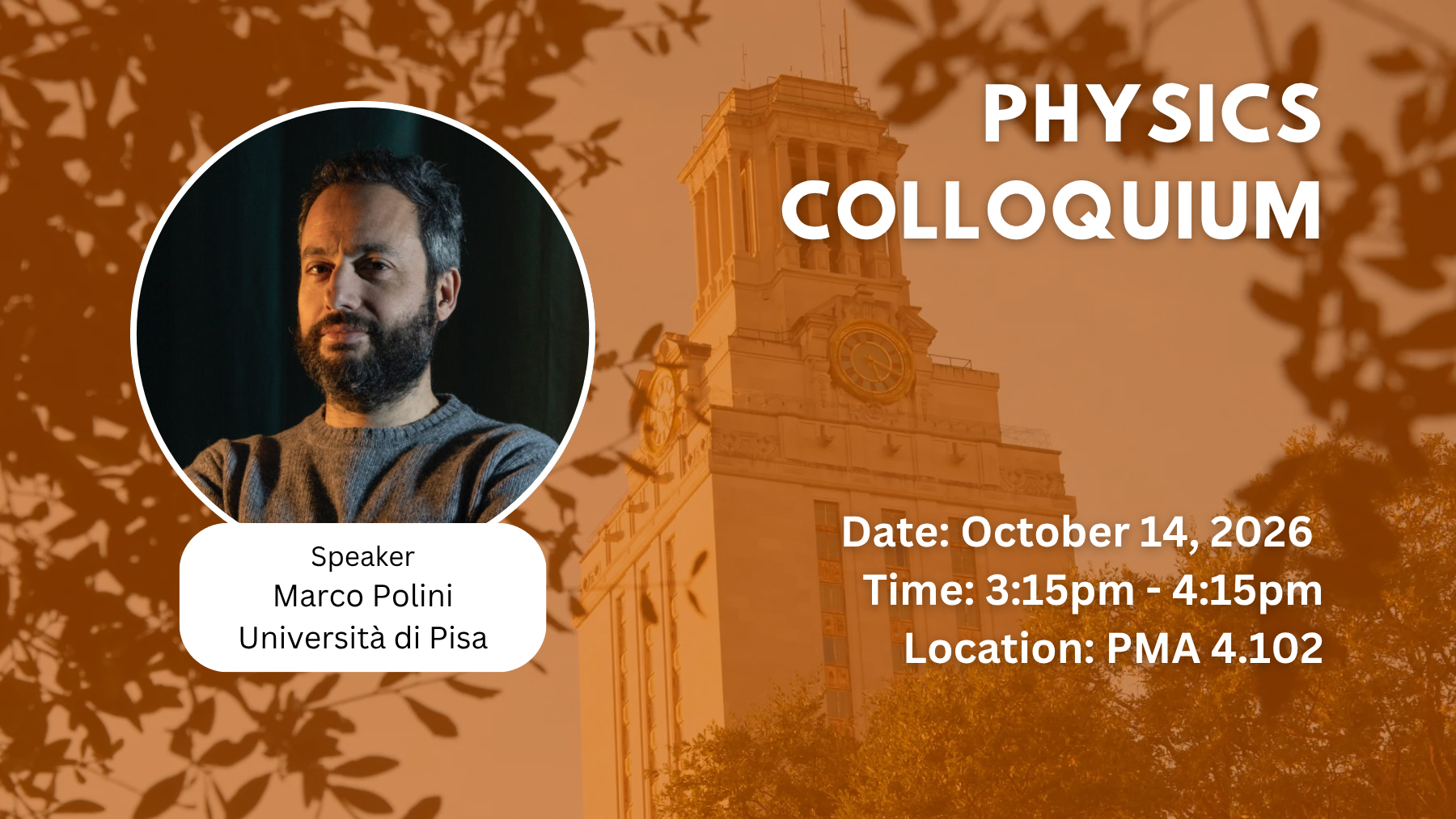
Oct
14
2026
Abstract
Cavity material engineering is an emerging field at the intersection of condensed matter physics, nanophotonics, and quantum optics. Its goal is to modify the properties of quantum materials using the quantum fluctuations of bosonic modes confined inside dark cavities. Optical-control approaches typically rely on intense laser pulses that drive a material far from equilibrium. Cavity material engineering takes a complementary route: it controls quantum materials through vacuum fluctuations alone, without externally populating the cavity modes. There is, however, a catch. In conventional diffraction-limited cavities, such as optical Fabry-Pérot resonators, the coupling between photons and electrons is governed by the small parameter , where is the Fermi velocity and the speed of light, so that their effects on ground-state properties are expected to be as tiny as Lamb shifts and Casimir-Polder forces. Can the fluctuating electromagnetic environment around a quantum material then change its ground state and its low-energy properties in measurable ways?
Focusing on two-dimensional (2D) materials, in this Colloquium I will argue that the answer is yes, provided that the cavity defies the devilish smallness of . Deep-subwavelength cavities made of natural hyperbolic van der Waals crystals, such as hexagonal boron nitride, do exactly that: they host longitudinal, quasi-static polaritons that live far from the light cone and couple to electrons much more strongly than transverse photons. I will first present a theoretical framework that quantifies how dark subwavelength cavities affect quantum materials, and that identifies the physical channels through which the cavity acts. I will then turn to electrical transport. I will show that Shubnikov-de Haas oscillations, a paradigmatic magneto-transport phenomenon in 2D metals, are modified, intrinsically and independently of disorder, by the bosonic modes of a deep-subwavelength polaritonic cavity, which renormalize the Landau parameters of the underlying Fermi liquid. Finally, I will show that the dielectric environment can even induce superconductivity. Resonant coupling between the plasmons of a 2D metal and the optical phonons of a nearby polar dielectric generates a polariton-mediated pairing interaction. Eliashberg perturbation theory for massless Dirac fermions predicts that relatively high-temperature superconductivity can emerge in bilayer graphene twisted slightly above the magic angle and surrounded by a terahertz polar dielectric.
Together, these results identify resonant strong coupling between collective electronic excitations and polaritonic modes as the microscopic mechanism at work. The lesson I have learned so far is simple: to reshape a quantum material, light does not need to shine. It only needs to be confined in the right way.
Location
PMA 4.102 (Wheeler Auditorium)