
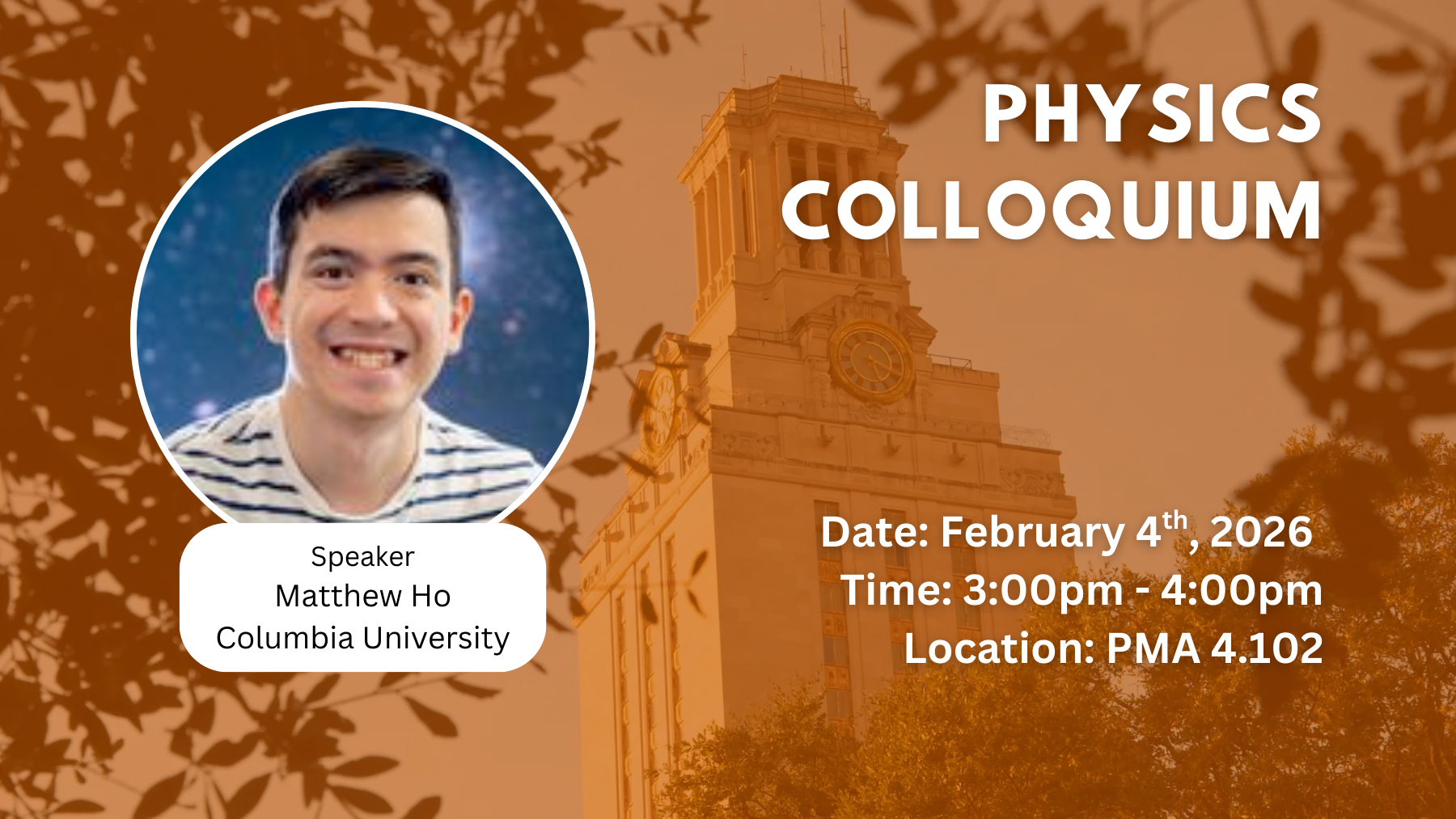
Physics Colloquium with Matthew Ho
Feb
4
2026
Feb
4
2026
Description
Abstract: Modern cosmological surveys are mapping the universe at an unprecedented scale and resolution, offering a stringent testbed to probe the physics of dark matter, dark energy, and structure formation. Machine Learning (ML) is transforming how we process these massive datasets, capturing rich, complex information that traditional methods discard. In this talk, I will overview how ML is bridging new connections between fundamental theory, observational data, and numerical simulations, maximizing the potential for scientific discovery without sacrificing statistical rigor. I will show how ML has dramatically improved our ability to constrain theory from observations, demonstrating diverse applications from weighing galaxy clusters to inferring cosmological initial conditions. I will present generative emulators that scale high-fidelity simulations to cosmological volumes, enabling the first-ever ML analysis of the full SDSS CMASS dataset. Finally, I will present interpretability techniques that verify our models learn genuine physics, ultimately using these learned representations to reveal new theoretical connections.
Location
PMA 4.102 (Wheeler Auditorium)