
Physics Colloquium with Robert Boyd
Oct
21
2026
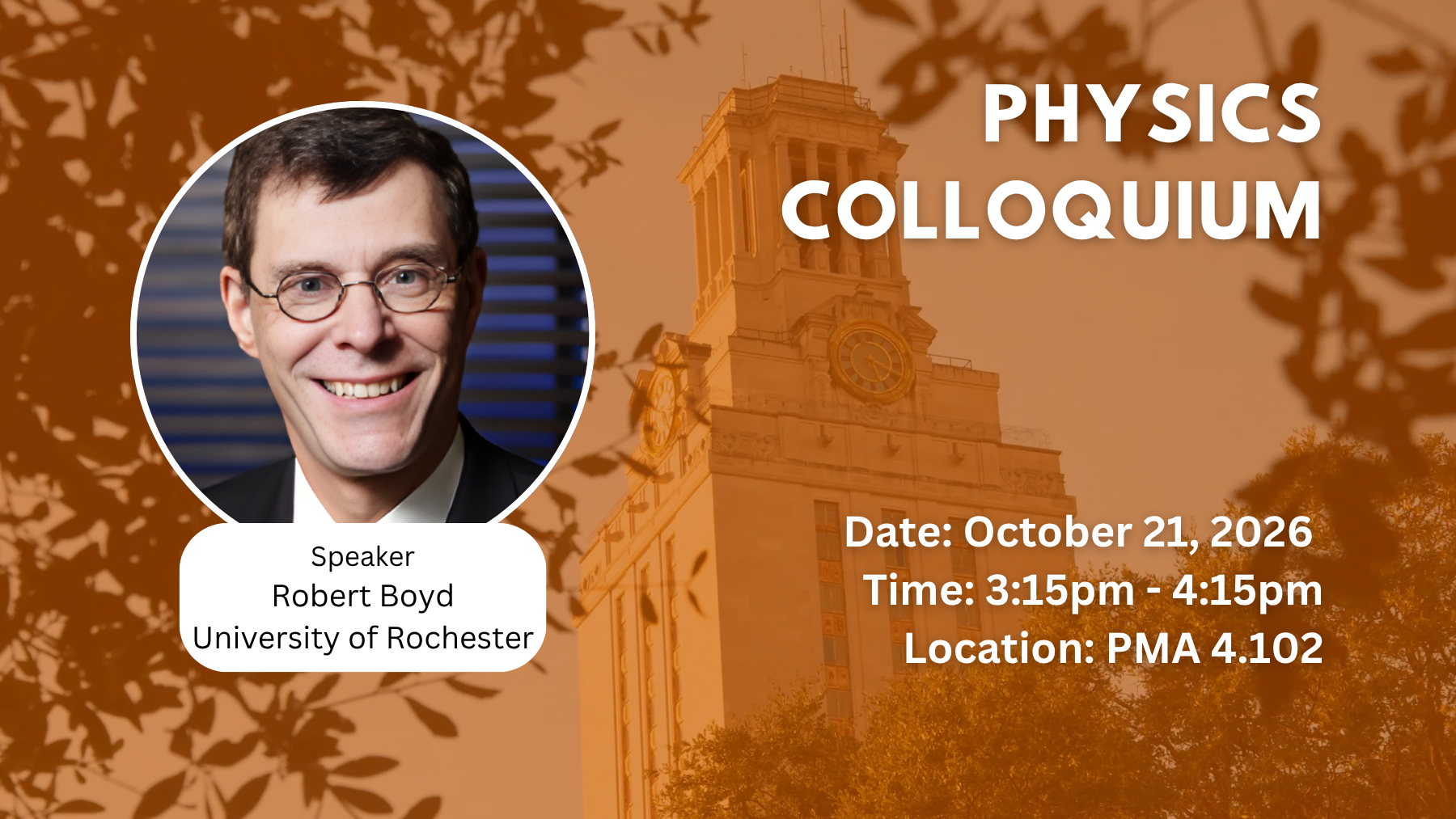
Oct
21
2026
Abstract
Materials with superior nonlinear optical properties are expected to play a key role in the development of future photonic devices and protocols for applications including quantum technologies, machine learning, and image acquisition and processing. Recent research approaches on means to achieve these enhanced optical properties include the following: Optical materials display greatly enhanced nonlinear optical response at wavelengths for which the real part of the permittivity vanishes (this is the so-called epsilon-near-zero, or ENZ condition) [Science 352, 795, 2016]. Recent work stresses the development of both homogeneous ENZ materials and of metamaterials designed to display ENZ behavior at desired wavelengths. One example of this latter approach is the use of metal-dielectric multilayer stacks, with the optical materials and layer thicknesses selected to produce ENZ behavior at any wavelength in the visible range. Still another approach entails the fabrications of nanoscale optical cavities comprised of one linear end mirror and one nonlinear end mirror. These cavities display highly nonlinear and complex dynamic behavior because of the interplay between cavity resonances and the resonance behavior of the nonlinear cavity end mirror. The usefulness of these novel materials will be illustrated by examples of their use in several current applications.
1.Alam, Leon, and Boyd, Science 352, 795 (2016).
Bio
Robert Boyd was born in Buffalo USA. He received the BS degree in physics from MIT and the PhD in physics from the University of California at Berkeley. His PhD advisor was Charles Townes, and his thesis involves nonlinear optical methods in infrared astronomy. He joined the University of Rochester in 1977 and in addition became Professor of Physics at the University of Ottawa in 2010. His research involves optical physics, quantum optics, and nonlinear optics. He has written two books, published over 400 research papers, and been awarded ten patents. He is a member of the Heidelberg Academy and the Royal Society of Canada. He is a winner of the Townes Award, Schawlow Prize, and a Humboldt Research Award.
Location
PMA 4.102 (Wheeler Auditorium)