
Physics Colloquium with Stephen Ekker
Oct
7
2026
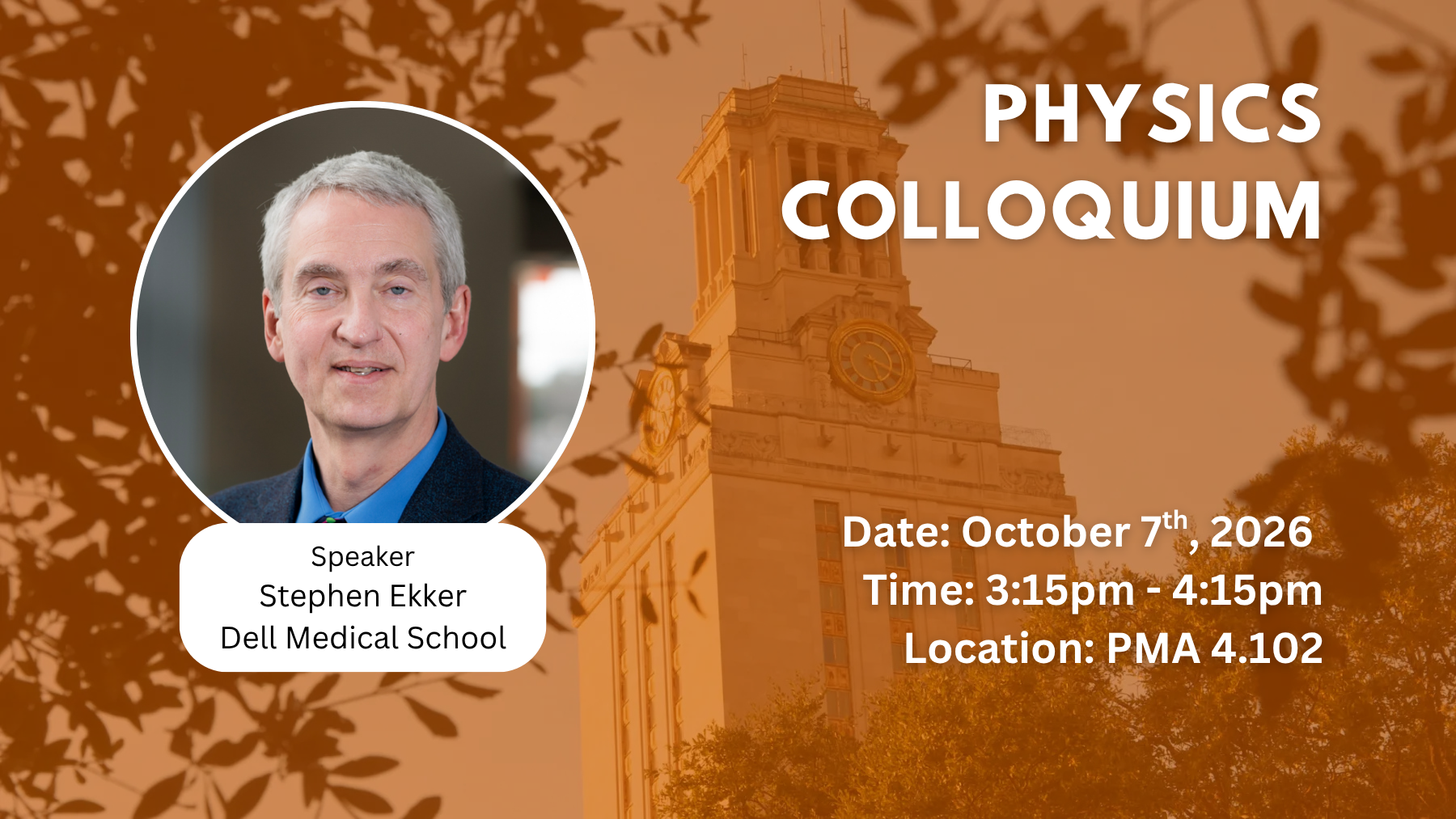
Oct
7
2026
Abstract
Biology is often described as working through the two separable components of energy production (i.e. mitochondria, photosynthesis) and information (i.e. DNA, RNA). However, we know biology depends on more than molecular identities and includes known and unanswered questions around how electrons, light, and spins move through living systems. This talk explores mitochondrial electron transfer, energy handling in photosynthesis and melanin, and emerging protein-based quantum sensors. Four recently developed platforms illustrate tangible tools for probing spin-dependent chemistry and cellular state. Building on these advances, we ask whether mitochondria could retain readable histories of prior inputs—and what experiments would distinguish conventional biochemical persistence from quantum mechanisms. Established findings and exploratory hypotheses frame new opportunities at the physics–biology interface.
Bio
Stephen C. Ekker, PhD. trained first as a semiconductor physics engineer before turning to biology, where he has spent his career learning to code the operating system of life: DNA. His work spans genome engineering, zebrafish disease modeling, molecular tool building, entrepreneurship, and translational medicine. He now explores how physics, computation, and biology may converge in a new generation of programmable living systems.
Location
PMA 4.102 (Wheeler Auditorium)