
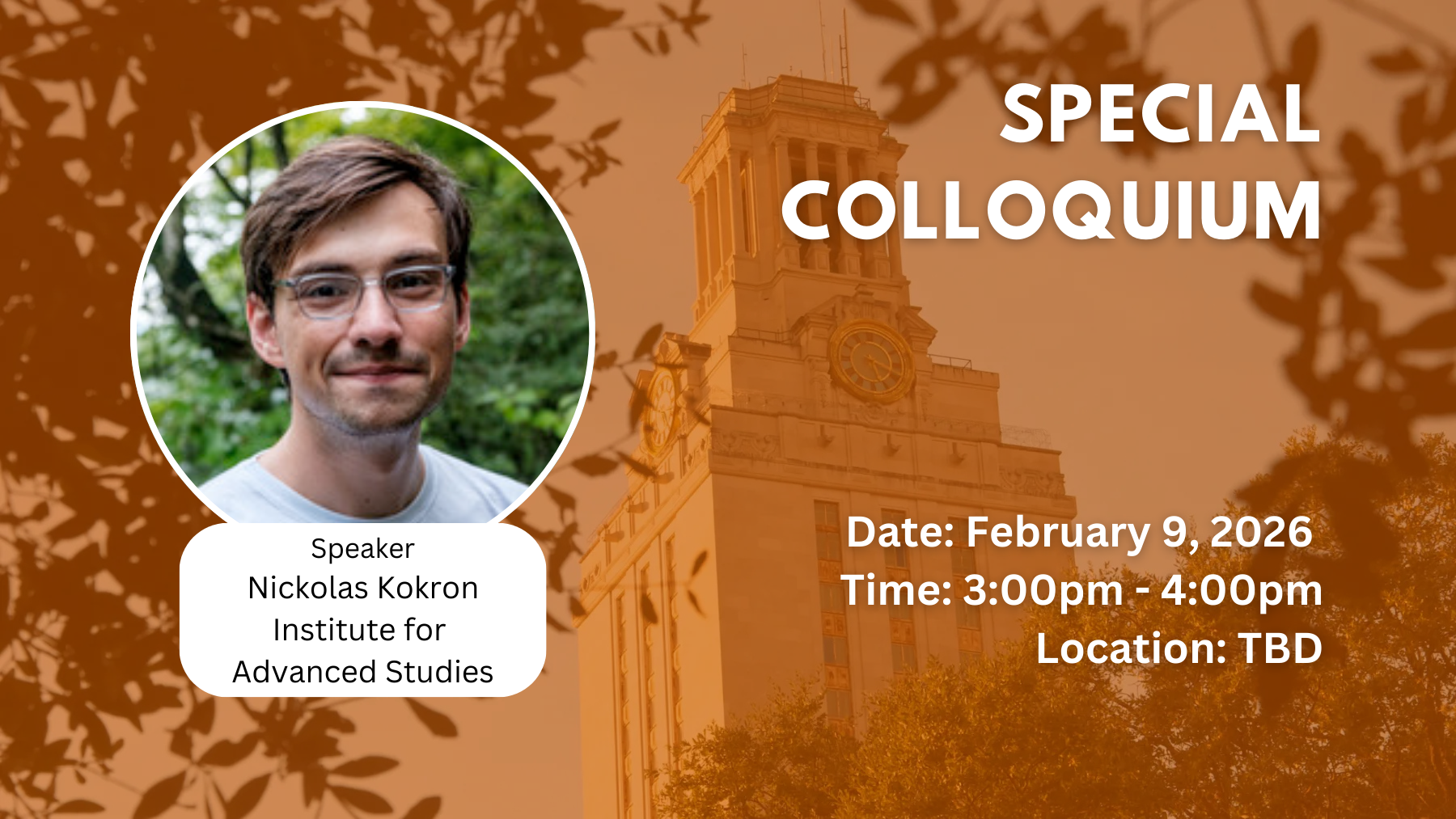
Special Colloquium with Nickolas Kokron
Feb
9
2026
Feb
9
2026
Description
Abstract: The concordance ΛCDM model, with six parameters individually measured to nearly 1% precision, describes essentially all large-scale observations of the Universe made so far. These precise measurements have historically come from observations of the cosmic microwave background (CMB), the Universe's baby picture. Ongoing cosmic surveys, probing the Universe several billion years after the CMB is formed, are delivering independent stress-tests of this cosmological model. Potential discrepancies between CMB and late-time measurements are hailed as tell-tale signs of the breakdown of ΛCDM and the onset of new physics, such as unveiling the properties of dark energy, a measurement of the sum of neutrino masses, or hints on the fundamental nature of primordial fluctuations in the early Universe.
However, inaccuracies in our theory for the formation of structures in the Universe can masquerade as new physics and risk leading the community astray. In this talk, I will discuss the challenge of predicting the evolution of the Universe's large-scale structure at the appropriate level of accuracy in the era of precision cosmology. I will discuss both analytic and computational techniques to model this process, and argue that there exist principled ways to combine these techniques such that they are more powerful than the sum of their parts. This hybrid theory is sufficiently accurate to describe next-generation cosmological data and is already playing a key role in extracting the most amount of information from galaxy and weak gravitational lensing surveys.