
WI Seminar - Gautham Narayan
Event starts on this day
Nov
17
2026
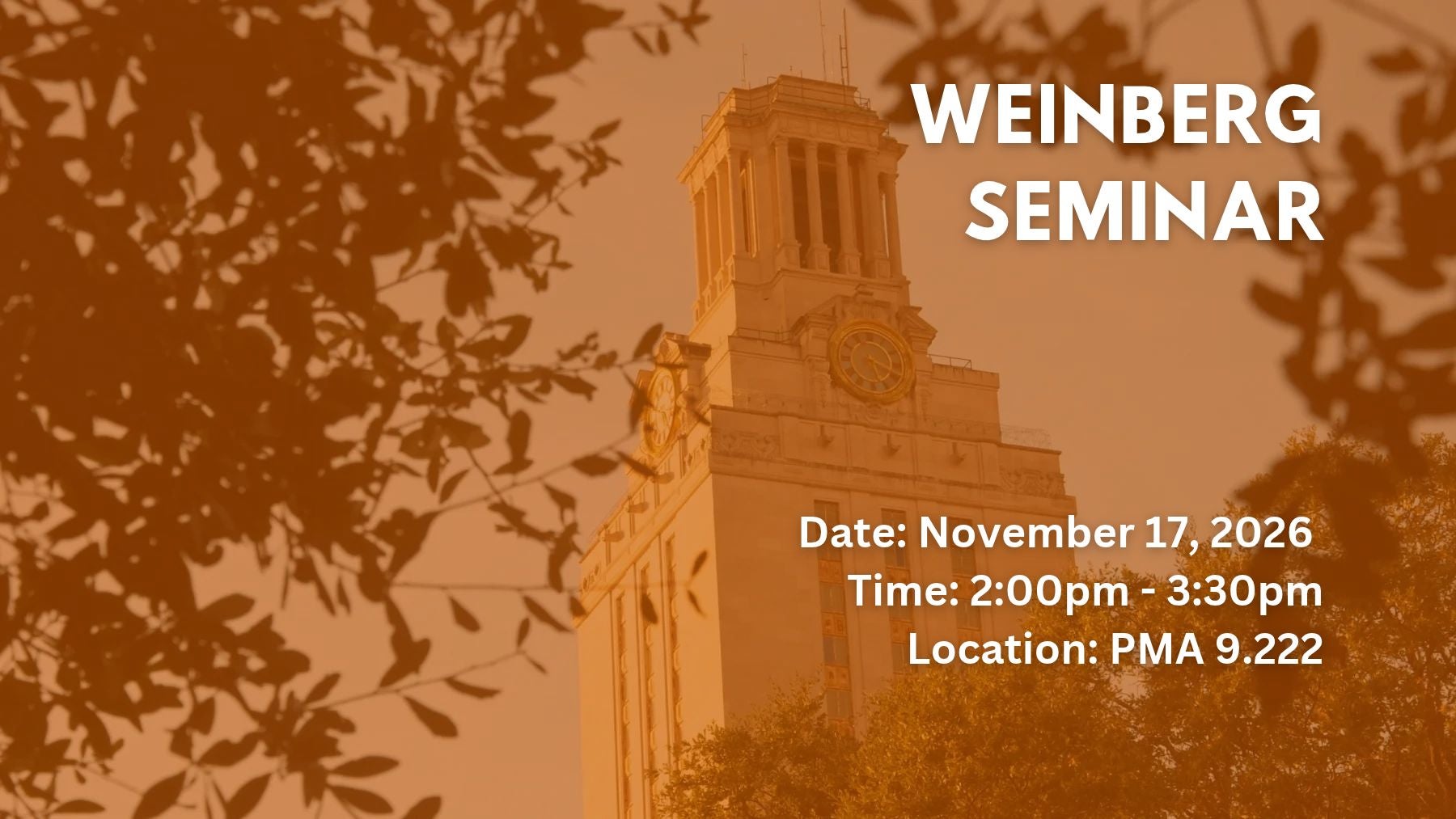
Event starts on this day
Nov
17
2026
Sirens, Candles and Needles: AI for Cosmology and Discovery with Rubin and LVK
Description
Abstract: GW170817 remains the only gravitational-wave source with a confirmed kilonova, and the fourth LIGO-Virgo-KAGRA (LVK) observing run ended without another confirmed electromagnetic counterpart to a neutron star merger. Bright standard sirens measure the Hubble constant (H₀) independently of the distance ladder we have built with type Ia supernovae (SNe Ia), and the SNe Ia now hint that dark energy may not be a cosmological constant. However, we cannot use sirens for cosmology without their counterparts, and we will increasingly rely on neural networks to find them and to do the inference. Rubin Observatory's Legacy Survey of Space and Time (LSST) began in June, and will soon report up to 10 million "alerts" every night, each one a source that has changed in brightness. Finding a kilonova that fades in days amongst these, the rarest of the rare needles in Rubin's haystack, requires that we combine gravitational-wave triggers with AI that can act on a few early observations. I'll describe our work in the Scalable Cyberinfrastructure for Multi-Messenger Astrophysics (SCIMMA) group to send LVK triggers to the Rubin scheduler, a neural network that identifies likely kilonovae within a gravitational-wave localization from sparse early photometry, and anomaly detection and similarity search to find the mergers and other rare transients that arrive with no gravitational-wave trigger at all. I'll then discuss SELDON, a foundation model from the NSF-Simons SkAI Institute that can predict what a transient will do next, even from early observations, and how AI methods like it have become core to the SN Ia cosmology analysis of the Dark Energy Science Collaboration (DESC). Neural networks are now also part of the inference, and I'll describe our neural post-Einsteinian tests of general relativity with GWTC-3 as an example. Together, these examples let us ask when we should believe a value of H₀, or a deviation from general relativity, that comes out of a neural network.
Bio: Gautham Narayan is an Associate Professor of Astronomy at the University of Illinois Urbana-Champaign, Deputy Director for Astrophysics Research at the NSF-Simons SkAI Institute, Spokesperson of the LSST Dark Energy Science Collaboration (DESC), and PI of SCIMMA (Scalable Cyberinfrastructure for Multi-Messenger Astrophysics). His research spans observational cosmology, time-domain and multi-messenger astrophysics, and the application of statistics, data science, and AI to astronomical datasets. He develops methods for real-time detection and classification of transients, including the electromagnetic counterparts of gravitational-wave sources, Bayesian models for cosmological inference with Type Ia supernovae, neural-network tests of general relativity with gravitational-wave catalogs, and foundation AI models for the Vera C. Rubin Observatory's Legacy Survey of Space and Time (LSST). He received his Ph.D. in Physics from Harvard University in 2013, and was previously the Lasker Data Science Fellow at the Space Telescope Science Institute.