
WI Seminar- Michael Coughlin
Oct
6
2026
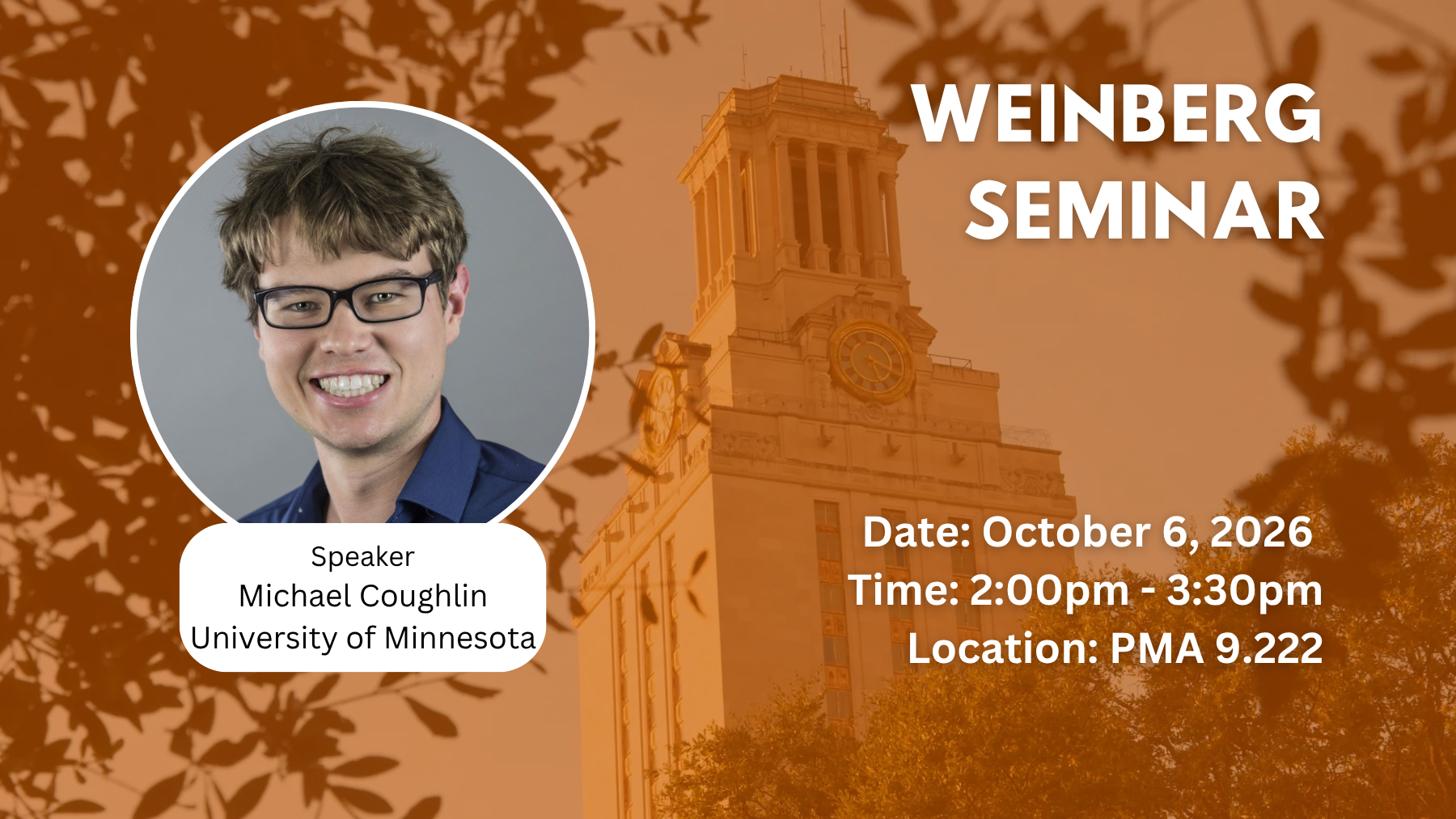
Oct
6
2026
Abstract
electromagnetic counterparts by gravitational-wave detectors, a new
era of multi-messenger astronomy has begun. In this talk, I will
describe how the gravitational-wave community is using these mergers
to constrain the unknown equation of state of cold supranuclear
matter, and to measure the Hubble constant. I will then discuss how
current ground based optical surveys and dedicated follow-up systems
are being used to identify more of these, and how we are developing
models to test what we find. We will close with near-term prospects
for the field.
Bio: Michael Coughlin is an Associate Professor in the School of Physics and Astronomy at the University of Minnesota. His research uses multi-messenger astronomy—combining gravitational-wave and electromagnetic observations—to develop a more complete understanding of the Universe. In particular, he studies binary neutron-star mergers using gravitational-wave data together with observations from wide-field optical telescopes, such as the Zwicky Transient Facility (ZTF), to identify their electromagnetic counterparts. He also searches for sources that may be observed by the future space-based gravitational-wave detector LISA, including white-dwarf binaries in the Milky Way and binary black-hole mergers. He received his Ph.D. from Harvard University in 2016 and currently serves as Chair of LIGO’s Low-Latency Alert System.