UT-Designed Laser Accelerator Will Drive a One-of-a-Kind Ultrafast X-ray Facility
The new facility will capture some of nature’s fastest processes in unprecedented detail.
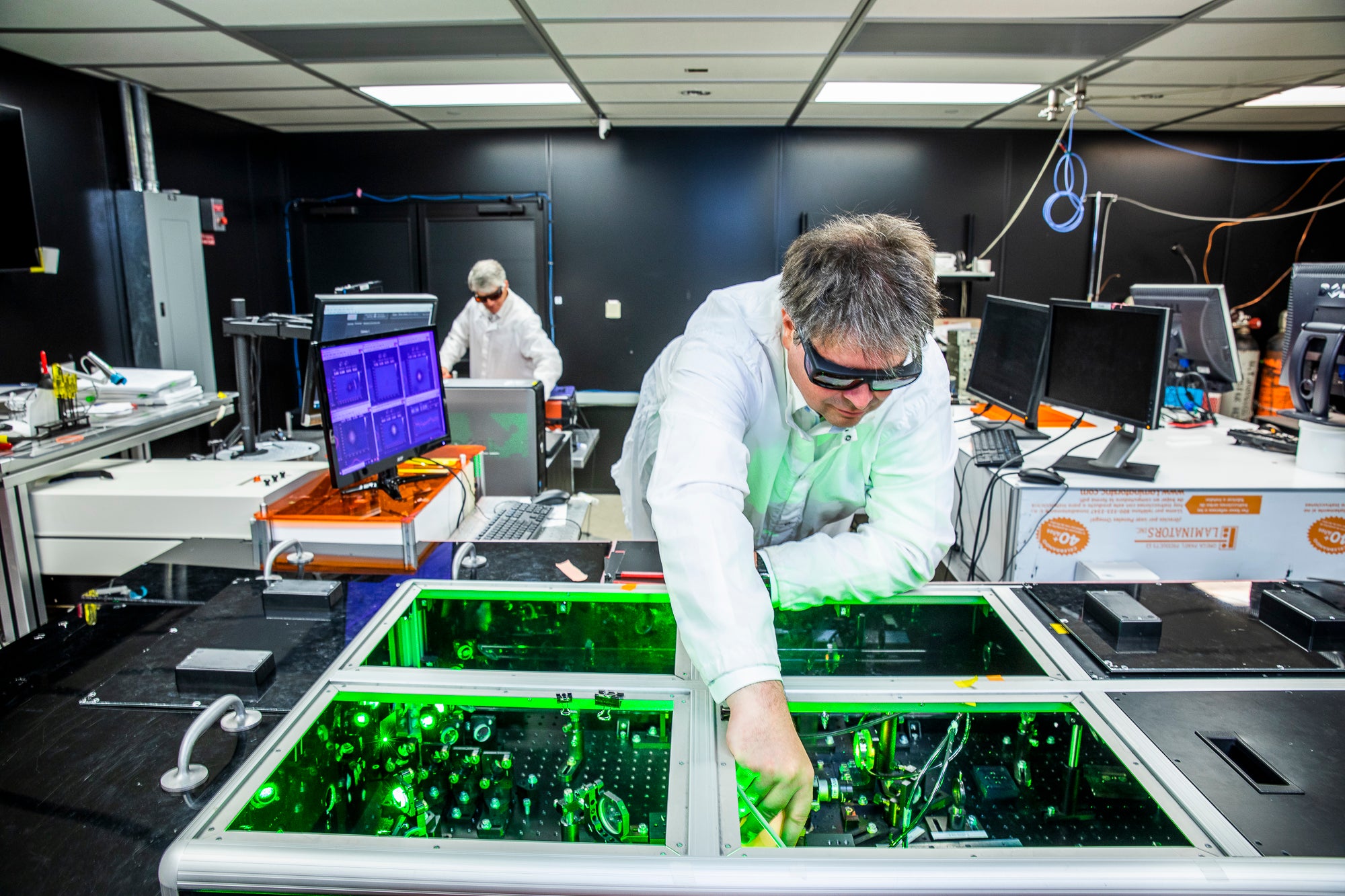
LaNeXT, a laser-driven facility, will combine intense synchrotron X-rays with ultrafast X-ray characterization involving technology from University of Texas at Austin physicist Manuel Hegelich. Credit: Manuel Hegelich
The National Science Foundation has awarded a grant to establish the Laboratory for Next-Generation X-ray Science and Technology (LaNeXT), a laser-driven X-ray facility that will allow researchers to watch some of nature’s fastest processes as they happen. The facility will be built at Lousiana State University in partnership with The University of Texas at Austin, which pioneered the compact laser-plasma accelerator approach that drives LaNeXT.
LaNeXT will give researchers the ability to capture motion at the atomic and molecular level in billionths and quadrillionths of a second. The facility will help scientists answer questions that are currently out of reach: How do molecules rearrange during chemical reactions? How do materials respond to stress, heat or light? How do biological molecules change shape as they carry out the processes of life?
“We have been developing these compact laser accelerators at UT for the last 20 years,” said Bjorn “Manuel” Hegelich, associate professor of physics at UT. “And now we are finally at the point where someone else can build one and use it as a tool. And we can go from the fundamental development of the tool to actually applying it to a much wider field that includes medicine, semiconductors, space and energy.”
Hegelich and his colleagues previously built a compact laser accelerator at UT called the University of Texas Tabletop Terawatt Laser (UT3) that can produce X-rays, electron beams or neutron beams. It produces extremely short pulses of energy once per second. Because it is much more compact and less expensive to operate than other comparable accelerators, it can be used in many more places and address many more types of questions.
The LaNeXT facility will include a next-generation version of the UT accelerator that fires 100 times per second, effectively increasing the average power output by a factor of 100 and enabling some experiments to run 100 times faster.
Once complete, LaNeXT will generate X-ray pulses as short as 30 femtoseconds. One femtosecond is one quadrillionth of a second. In that amount of time, light travels only about the width of a small bacterium. For scientists, this kind of speed is essential, yet rare. Many chemical, biological and materials processes happen so quickly that today’s instruments often capture only the “before” and “after,” leaving the most important steps invisible.
“One of the biggest challenges in modern science is that the most important changes often happen too fast to see directly,” said Gerald Schneider, chemistry professor and leader of the LaNeXT team at LSU. “For a long time, scientists have had to infer what happens in the middle of a reaction by looking at the starting point and the final result. LaNeXT will let us watch those hidden steps unfold. That means we can ask questions—and solve problems—that were previously beyond reach.”
Schneider compares the challenge to the wagon-wheel illusion in old Western movies, where a wheel appears to spin backward because the camera isn’t recording fast enough.
“The motion is real, but what we see depends on how fast we take the pictures,” Schneider said. “If our scientific camera is too slow, we can misunderstand what is actually happening. LaNeXT gives us a much faster camera for the molecular world.”
Combined Capabilities Found Nowhere Else
LaNeXT will combine three powerful tools in one place: a synchrotron (a type of accelerator where charged particles travel in a large circular loop and can emit a beam of X-rays, among other things); UT’s compact laser accelerator (for generating ultrafast X-rays to probe changes in the system); and advanced sample fabrication.
Among the first experiments, researchers will expose semiconductor samples to the intense synchrotron beam and use LaNeXT’s ultrafast laser-based X-rays to measure the resulting changes in the material. This globally unique combination of synchrotron exposure and ultrafast X-ray probing has relevance amid the nation’s effort to rebuild semiconductor manufacturing in the U.S., critical to the tech economy and to national security.
LaNeXT provides a path toward a new and more energy-efficient particle accelerator, featuring more compact technology that could lead to substantial cost reductions for the four big synchrotron facilities supported by the Department of Energy—potentially saving the federal government up to $20 billion per year in electricity bills—while introducing new scientific opportunities, which would be tested first nationwide at LaNeXT.
Adapted from a press release by Louisiana State University.